
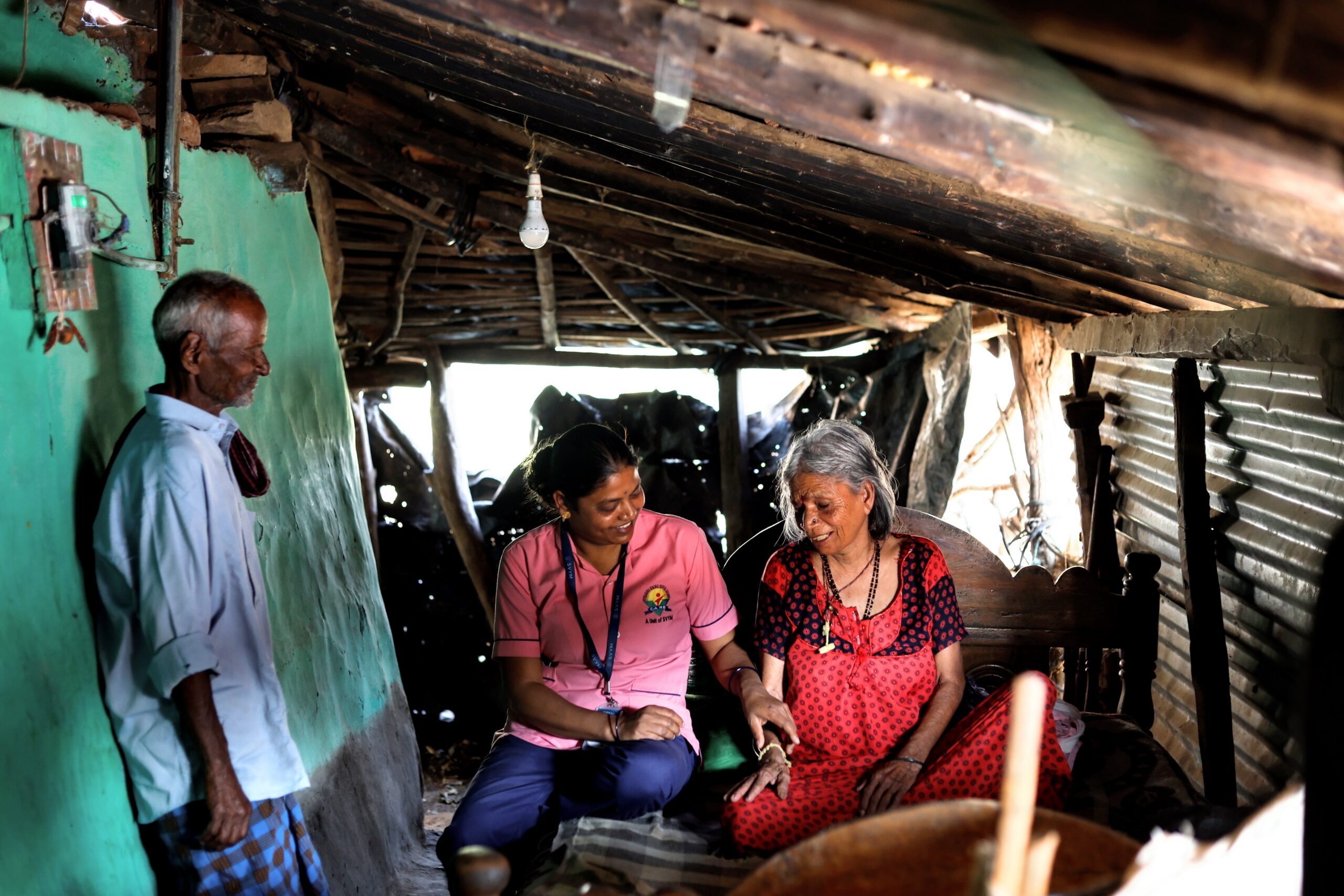
There may be an end to cure, but there’s no end to care.
SVYM’s Palliative Care Program has evolved from early home-based care experiences — including caring for people living with HIV — into a community-centred, community-owned and community-demanded platform for holistic care, caregiver training, research, volunteering and partnerships across Karnataka.
Objective
To improve the quality of life of individuals and families facing serious, chronic and life-limiting illnesses through accessible, holistic, free-of-cost palliative care that addresses physical, emotional, psychosocial, financial and spiritual needs, while building community capability and strengthening palliative care knowledge and systems.
A palliative care movement shaped by dignity, continuity and community
SVYM’s palliative care journey did not begin as an isolated clinical service. It grew from field experiences in home-based care — especially while supporting people living with HIV and other serious illnesses — which deepened the organisation’s understanding of suffering, dignity, caregiver burden and the need for a holistic approach to treatment.
Today, the programme combines community and institution-based care, public-system and academic partnerships, caregiver training, volunteer participation, fundraising through Swaraanubhuthi and a growing contribution to palliative care knowledge and practice. The result is not just a service, but a platform that helps families navigate long illness with greater support and dignity.
Read more about the evolution of the palliative care model
SVYM’s current palliative care model is best understood as an expansion of care philosophy. The organisation’s earlier work in HIV and home-based care brought a deeper sensitivity to chronic illness, pain, stigma, dependence, family fatigue and the need for compassionate accompaniment. Those insights later informed palliative care in a more structured way.
The programme has steadily moved from improving accessibility to care, towards helping communities and families themselves become active participants in care. In this sense, the model is community-centred, community-owned and community-demanded. It is also strengthened by institutional collaboration — with hospitals, medical colleges, Government systems and academia helping make care more accessible and more legitimate within the wider health ecosystem.
SVYM’s palliative care has also evolved beyond direct service delivery. Caregiver training, volunteer engagement, the Har Ghar Jeeva Sevak initiative, knowledge sharing, training for health professionals, CMEs and research-oriented contributions all reflect the growth of palliative care as an emerging field rather than merely a programme.
This broader evolution matters because palliative care is not only about terminal care. It is about reducing suffering, improving quality of life, helping families cope, and creating a social and institutional environment where care beyond cure becomes possible and accessible.
There’s no end to Care
A fuller introduction to SVYM’s Palliative Care Program — its philosophy, its care model and the people and partnerships that have helped the programme grow.
Care that has continued to grow with community support
Growth in the Programme’s Reach
SVYM’s public palliative-care pages report both current yearly activity and cumulative growth over time. The figures above help show scale and progression without treating different years and reporting formats as the same measure.
From a small group of volunteers in Mysuru to a growing multi-district dedicated palliative care network
The programme grew step by step — from learning how to care for people with chronic illness at home, to building a dedicated institutional centre, forming public and academic partnerships, expanding to new districts and strengthening community capability.
Chronic-care and palliative principles emerge from earlier health work
SVYM’s experience of caring for people living with HIV and other serious illnesses strengthened an understanding of pain relief, dignity, psychosocial support and continued care. Vivekananda Memorial Hospital also began building palliative-care capability through training and practice.
Home-based palliative care begins
A small team of volunteers and health professionals starts reaching families at home in Mysuru — taking care to people who found repeated institutional visits difficult or impossible.
Swaraanubhuthi begins turning care into a community cause
The annual musical charity initiative becomes an early community-centred fundraising and awareness platform, allowing individuals, artists, donors, volunteers and families to participate directly in sustaining free palliative care.
SVYM and Mysore Medical College and Research Institute formalise collaboration
A Memorandum of Understanding with Mysore Medical College and Research Institute (MMCRI) helps create the pathway for a dedicated institutional Palliative Care Centre at the Princess Krishnajammanni Tuberculosis & Chest Diseases Hospital (PKTB & CD Hospital) campus in Mysuru.
A 16-bed centre is dedicated to Mysuru; care expands to Hassan
The 16-bed Palliative Care Centre at the PKTB & CD Hospital campus becomes the institutional anchor for Mysuru through the SVYM–MMCRI collaboration. Around the same phase, palliative care is initiated in Hassan in collaboration with the Hassan Institute of Medical Sciences (HIMS).
Palliative care is anchored in Dharwad
SVYM expands home-based palliative care to Dharwad, working with the Dharwad Institute of Mental Health and Neurosciences (DIMHANS) and local health-system partners.
Home-based palliative care reaches Bengaluru
The programme establishes a home-care footprint in Bengaluru, bringing the community-based model into a large urban setting and learning how palliative care needs differ across city communities.
Institution-based palliative care begins through Sevakshetra Hospital
SVYM and Sevakshetra Hospital enter a formal collaboration to extend institutional palliative care for deserving individuals and families in Bengaluru.
The network expands further
Palliative care is launched in Kodagu / Madikeri through home-based services, while a dedicated home-care vehicle strengthens reach in and around Saragur. The programme now spans six locations across multiple districts.
The programme grows beyond service delivery
Har Ghar Jeeva Sevak, professional training, academic immersion, research presentations and participation in national palliative-care forums strengthen the programme’s role as both a care provider and a contributor to the wider palliative-care ecosystem.
A collaborative palliative care model across locations
SVYM’s palliative care is strengthened by a partnership model that works through institutions, community networks and local service ecosystems rather than as a standalone programme.
Mysuru · MMCRI & PKTB Hospital
The 16-bed Palliative Care Centre at the Princess Krishnajammanni Tuberculosis & Chest Diseases Hospital (PKTB & CD Hospital) campus is a collaborative venture with the Mysore Medical College and Research Institute (MMCRI). The institutional facility was dedicated for palliative care through this partnership, complementing home-based services in Mysuru.
MMCRI and SVYM jointly review the programme through steering mechanisms, collaborate on training and CME sessions for medical departments and students, and strengthen the clinical-academic linkage. MMCRI also supports meals for inpatients and accompanying family members, reducing an important everyday burden during prolonged care.
Saragur · Vivekananda Memorial Hospital
At VMH, palliative care is integrated into the hospital’s care delivery model itself rather than functioning as a standalone service. Patients with chronic and incurable illnesses receive symptom management, rehabilitation, counselling and family support as part of their wider continuum of care, with community outreach extending this approach into rural and tribal settings.
Hassan · Hassan Institute of Medical Sciences
SVYM works with the Hassan Institute of Medical Sciences (HIMS) to provide institution- and home-linked palliative care for deserving individuals and families, combining a Government teaching-hospital platform with community follow-up.
Dharwad · Dharwad Institute of Mental Health and Neurosciences
SVYM works with the Dharwad Institute of Mental Health and Neurosciences (DIMHANS) and extends home-based palliative care in Dharwad, demonstrating how local institutional collaboration can help establish palliative-care access in new geographies.
Bengaluru
SVYM and Sevakshetra Hospital have joined hands to advance palliative care in Bengaluru, adding an urban partnership dimension to the programme.
Kodagu / Madikeri
The programme’s current public communication includes Kodagu / Madikeri as part of the wider centre network, reflecting continued geographic growth of the model.
Why the partnership model matters: it helps palliative care become community-demanded and system-supported at the same time — rooted locally, but strengthened by medical, academic and institutional legitimacy.
See how the model is taking shape in Bengaluru and Dharwad
Palliative Care in Bengaluru
SVYM’s Bengaluru journey shows how home-based and institutional palliative care can grow through local collaboration and a shared commitment to accessible care.
Palliative Care in Dharwad
The Dharwad film reflects the programme’s expansion through home-based care and local institutional partnerships, bringing palliative support closer to families.
From accessible care to capability building, research and a wider movement for care
Accessible care
Institution and home-based palliative care made support reachable for individuals and families who would otherwise struggle to access continued care.
Caregiver training
Families and primary caregivers were trained in basic home care, helping them care with greater skill, confidence and dignity.
Community participation
The programme increasingly equips families, volunteers and community members to recognise care needs, support caregivers and participate meaningfully in extending care beyond institutions.
Professional training
Trainings for healthcare workers, CMEs and integration sessions help palliative care move from being a niche service to a wider health-system capability.
Research & knowledge
The programme increasingly contributes to the knowledge base of palliative care through experience-sharing, field learning, educational engagement and clinical reflection.
Volunteer engagement
Medical professionals, counsellors, physiotherapists, retired professionals, students, writers and community members all have a role in extending care beyond cure.
Building the human and social capital: this programme does not only provide care; it also builds the capacities, relationships and local ownership needed for compassionate care systems to grow and last.
Taking the capacity to care into every home and community
Har Ghar Jeeva Sevak represents the next stage in SVYM’s community-centred palliative care journey: moving beyond the idea that compassionate care must always depend on a specialist or institution, and equipping ordinary people with basic life skills, awareness and confidence to support someone living with serious illness.
When care becomes a shared social capability
Families often spend far more time with a person living with chronic or life-limiting illness than any health professional can. Har Ghar Jeeva Sevak therefore focuses on strengthening the people already present around the patient — family members, caregivers, volunteers, youth and community members — with practical knowledge and a compassionate understanding of care.
The initiative supports SVYM’s larger vision of community-demanded, community-driven and community-owned palliative care, helping build the human and social capital required for care to remain available beyond the reach of formal institutions.
Understand care needs earlier
Build awareness around serious illness, suffering, symptom burden and when families may need additional support.
Strengthen everyday caregiving
Help caregivers and community members develop practical life skills that make home care safer, more confident and more compassionate.
Know when and where to seek help
Link families with palliative care teams, institutions, volunteers and other services when needs exceed what can be managed at home.
Turn empathy into community action
Create a larger circle of people who can volunteer, advocate, accompany families and help make palliative care a shared community responsibility.
From delivering care to contributing to the evidence and practice of palliative care
As the programme has matured, SVYM has increasingly used its field and institutional experience to train health professionals, engage medical and allied-health students, present research and participate in national forums led by the Indian Association of Palliative Care (IAPC).
Research presented on quality, symptom burden and cost
At the 32nd Annual International Conference of the Indian Association of Palliative Care, SVYM presented a poster on quality of life and patient satisfaction in home-based care and a research paper on symptom burden and the cost-benefit of community-based palliative care in Karnataka.
Dr Gowthami Palnati received second prize for the research-paper presentation.
A growing research presence
SVYM’s Palliative Care Program presented three research papers and was represented on two conference panels at the 33rd Annual International Conference of the Indian Association of Palliative Care.
Integrating palliative care into medical learning
SVYM and the Mysore Medical College and Research Institute jointly conduct educational programmes and departmental learning sessions. A 2024 CME on Integrated & Comprehensive Palliative Care brought together 287 healthcare professionals and students.
Building capability across the health system
The programme trained Department of Health and Family Welfare personnel, medical officers, community health officers, medical and nursing students and allied-health professionals — combining classroom learning with exposure to institutional and home-based care.
Learning from care as it is delivered
Hands-on postings and field exposure help medical interns, nursing students, physiotherapy students, social-work learners and other professionals understand palliative care as a continuum spanning symptom relief, counselling, family support, rehabilitation and community follow-up.
Learning with the wider palliative-care community
Through participation in IAPC conferences, scientific presentations, panels and professional exchange, SVYM brings its community-based experience into national conversations while learning from developments across the field.
Knowledge with a purpose: research and training are not separate from service delivery. They help refine the model, demonstrate what works, build professional capacity and strengthen the case for accessible palliative care within health systems.
A musical movement that helped palliative care grow
Swaraanubhuthi has played a crucial role in building public participation, donor support and emotional connection around SVYM’s Palliative Care Program. It has helped transform fundraising into a community movement for care beyond cure.
Care beyond cure
Swaraanubhuthi turns palliative care into a public cause, helping audiences, donors, sponsors, artists and volunteers come together around a humane and dignified response to suffering.
Artists who strengthened the movement
Over the years, well-known singers and musicians have lent their voice to Swaraanubhuthi, helping the cause of free-of-cost palliative care reach a wider community.
More than fundraising
The event has helped palliative care remain free-of-cost for deserving families, while also making the programme more visible, relatable and community-owned.
Music in support of care beyond cure
Swaraanubhuthi 2022
Rajesh Krishnan joins SVYM’s musical movement in support of palliative care and the idea of care beyond cure.
Swaraanubhuthi 2025
A later chapter of the annual musical charity event, bringing artists, supporters and the wider community together for palliative care.
Swaraanubhuthi 2026
Swaraanubhuthi continues as a musical movement for accessible palliative care, connecting participation and philanthropy with care for families facing serious illness.
Connect with SVYM’s Palliative Care Program near you
For palliative care support, referrals, volunteering or programme-related enquiries, connect with the SVYM team at the nearest location.
SVYM Palliative Care Centre
G.K. Ward,
Princess Krishnajammanni Tuberculosis & Chest Diseases Hospital (PKTB & CD Hospital),
KRS Road, Metagalli,
Mysuru – 570002
SVYM Vivekananda Memorial Hospital
Hanchipura Road,
Saragur, Saragur Taluk,
Mysuru District – 571121
Palliative Care Centre · Hassan Institute of Medical Sciences
Room No. 16/C, 1st Floor,
Teaching Hospital,
Hassan Institute of Medical Sciences (HIMS),
Hassan – 573201
SVYM Palliative Care Program
DVG Bhavana, Gokhale Institute of Public Affairs,
No. 2/86/1-A, 5th Main,
Bull Temple Road, M.R. Colony,
Bengaluru – 560004
SVYM Palliative Care Program
29/1B, Bhishma Nilaya,
8th Block, Cauvery Layout,
Madikeri, Karnataka – 571201
Community Based Activities · DIMHANS
Academic Block, First Floor,
Dharwad Institute of Mental Health and Neurosciences (DIMHANS),
Dharwad–Belagavi Road, Saidapur,
Dharwad – 580008
Two powerful ways to become part of the circle of care
SVYM’s Palliative Care Program is sustained not only by health professionals and institutions, but by people who choose to contribute resources, time, skills and presence. Individual giving and volunteering are both central to keeping care accessible and free of cost for deserving families.
Help a family receive care without worrying about the cost
Your contribution supports free-of-cost home visits, institutional care, counselling, caregiver support, assistive devices and the everyday costs involved in accompanying a family through serious illness.
Your presence and skills can make someone’s difficult journey gentler
Palliative care needs more than doctors. Medical professionals, counsellors, physiotherapists, yoga teachers, retired professionals, students, writers, photographers and community members can all find meaningful ways to serve.
Hospitals, medical colleges, foundations and CSR partners can also collaborate with SVYM to strengthen service delivery, training, research and new palliative care geographies.
Discuss an Institutional PartnershipHelp widen the circle of care
A donation can help keep care free of cost. A few hours of your time can support a patient or caregiver. A partnership can help an entire community gain access to palliative care.