
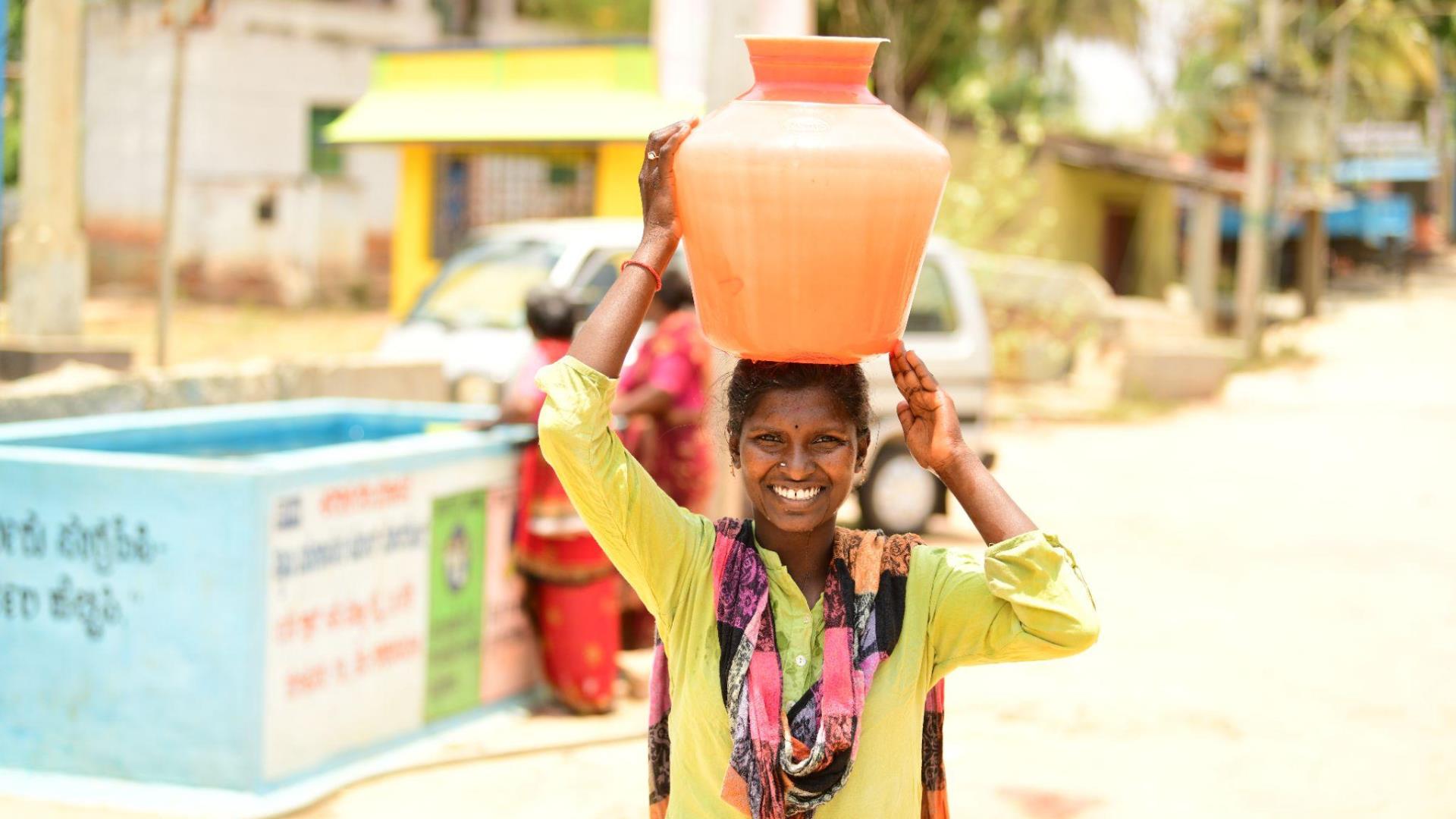
From a tap to trust.
From access to water security.
For SVYM, WASH has often been more than a service. Safe water, sanitation and hygiene have opened the door to long-term relationships with communities — creating the trust from which healthier, more resilient and more self-reliant communities can grow.
Objective
To improve community health and well-being by ensuring equitable access to safe water, sanitation and hygiene services while strengthening community ownership and the sustainable management of WASH resources.
Water has often been the first conversation
SVYM's WASH work began with basic questions of access — a functioning water point, a safe source, a toilet, a place to wash hands — and gradually expanded into behaviour change, institutions, community ownership, financing and water security.
Across rural and tribal communities, low-income settlements and institutions, SVYM has worked with families, schools, Anganwadis, healthcare facilities, Self-Help Groups, local governments and partners to improve both infrastructure and the systems needed to sustain it.
That evolution reflects a simple lesson: infrastructure matters, but lasting WASH outcomes depend equally on behaviour, local capability, ownership, financing and the health of the water source itself.
A tap can open more than a water line.
When a community sees a basic need being addressed reliably and respectfully, trust begins to grow. For SVYM, WASH has often created that first point of engagement — making space for conversations on sanitation, hygiene, health, education, livelihoods and wider community development.
Read more about how the approach evolved
SVYM's WASH work has moved across very different contexts over time: tribal settlements, drought-prone rural areas, schools, Anganwadis, healthcare facilities and community institutions. The form of the intervention changes with the context.
Some projects restore access by repairing a water point or RO plant. Others create rainwater-harvesting systems, improve sanitation infrastructure, strengthen hygiene behaviour, support women's Self-Help Groups to run WASH enterprises, or link water conservation to wider watershed management.
What connects them is a community-centred approach: solve the immediate problem, strengthen local capacity, and create conditions in which the solution can continue after the project period.
Source. Supply. Safety. Sustainability.
A WASH system is only as strong as the chain that keeps water available, accessible, safe and locally manageable.
Protect where water begins
Rainwater harvesting, recharge, restoration of water bodies and watershed measures strengthen the resource before it reaches the user.
Make access reliable
Water points, RO systems, storage, pipelines and institutional facilities help make water available where people live, learn and receive care.
Protect health and dignity
Water quality, fluoride-free drinking water, toilets, handwashing, hygiene practices and safe waste management reduce preventable risks.
Build ownership around the system
Community institutions, SHGs, local financing, behaviour change and public-system partnerships help WASH assets remain useful over time.
Different geographies. Different problems. An evolving response.
SVYM's WASH work has expanded by responding to the water, sanitation and hygiene realities of each geography rather than applying a single fixed project model.
Basic WASH needs become an entry point into community development
SVYM begins working on water, sanitation and hygiene — often through practical, visible improvements that help build relationships and trust with rural and tribal communities.
Water points, schools, hygiene and rainwater harvesting
WASH work was documented across Raichur & Gulbarga, Hassan, Nelamangala in Bengaluru Rural, H.D. Kote and Dharwad. The portfolio included restoration of water points, school and Anganwadi WASH, household rainwater harvesting, water-security awareness and hygiene engagement during COVID-19.
WASH expands into schools, Anganwadis, health facilities and community capacity
Across seven districts, SVYM strengthened WASH in institutions and rainwater harvesting while working with Jal Jeevan Mission to train community participants and promote the idea that water management is everyone's responsibility.
Healthier environments where people learn and receive care
Work in T. Narasipura and Nanjangud strengthened water, toilet, handwashing and waste services across schools, Anganwadis and healthcare facilities — linking WASH infrastructure with dignity, health and institutional resilience.
Financing WASH — from users to owners and entrepreneurs
Across 53 villages in 10 Gram Panchayats, Self-Help Groups restored RO plants, operated pay-and-use toilets, ran WASH marts and produced sanitation products. Revenue generation strengthened both livelihood opportunity and the sustainability of WASH services.
Water equity moves upstream into watershed management
The Kolar Watershed Project connected WASH and community rainwater harvesting with soil and water conservation, groundwater recharge, farm ponds, check dams, agroforestry and livelihood resilience.
Blended finance, safe water and community-managed systems
Current work restored defunct RO systems, strengthened school drinking-water and handwashing facilities, improved groundwater recharge and engaged SHG members to reinforce community ownership and long-term sustainability.
From households to institutions. From infrastructure to ecosystems.
Rural, tribal and low-income settings
Water access, sanitation, hygiene behaviour and conservation are designed around household and community realities, with local participation central to planning and upkeep.
Healthy spaces for children to learn
Safe drinking water, toilets, handwashing and hygiene education turn educational institutions into environments that support health, dignity and attendance.
WASH as part of safe care
Water, sanitation, waste systems and climate-resilient planning strengthen the infrastructure on which quality healthcare depends.
Ownership that can sustain services
Women's groups and local institutions can manage services, create livelihoods, generate revenue and ensure that WASH systems remain functional beyond the project period.
When hygiene became frontline protection
The pandemic made the relationship between water, hygiene, safe institutions and public health immediately visible. SVYM used its WASH presence to take safe-hygiene information into schools and homes, support frontline settings and strengthen WASH systems in healthcare facilities.
Hygiene behaviour at household scale
In H.D. Kote and Dharwad, 168 hygiene sessions across 22 Government schools contributed to knowledge, attitude and practice work reaching 7,044 children. The same programme used household visits to continue hygiene communication beyond the school gate.
Strengthening WASH where care is delivered
COVID-19 also sharpened the focus on healthcare-facility WASH in Mysuru. Sixteen facilities were assessed, 685 health staff and community members were trained in WASH and Kayakalpa concepts, and facility-level planning and advocacy supported WASH-specific investment.
Safe water, healthier schools and stronger local ownership
During FY 2025–26, the WASH programme focused on Raichur, using a blended-finance approach to restore water systems, strengthen institutional WASH and support community management.
Sharing responsibility for long-term WASH
SVYM's Raichur model brings together community institutions, public systems and financing mechanisms so that access is not dependent on a one-time infrastructure investment alone.
Women as managers and WASH entrepreneurs
SHGs have demonstrated how safe-water systems, toilets, sanitation products and WASH marts can become both community services and local economic opportunities.
See the model in the field
These field stories show how SVYM's WASH approach has taken different forms across communities, institutions and landscapes.
 Nelamangala · Bengaluru Rural
H. Palya — a model rainwater-harvesting village
Household and community rainwater harvesting shows how practical conservation can become part of everyday village water security.
 Raichur
Financing WASH — ownership with an economic engine
Self-Help Groups and local enterprises demonstrate how revenue generation can help services remain functional and locally owned.
 H.D. Kote · Mysuru District
A model school for WASH
Institutional WASH combines infrastructure, student participation and hygiene practice to create healthier learning environments.
 Kolar
Kolar
Watershed management — protecting water before the tap
Recharge, conservation and landscape-level measures extend the WASH conversation upstream to long-term water security.
When the source is under stress, the solution must move upstream.
SVYM's newer watershed-management work complements WASH by addressing the ecological systems that determine whether water remains available in the first place.
Hold rain where it falls
Farm ponds, check dams, nala bunds and recharge structures slow runoff and replenish groundwater.
Protect the landscape
Trench-cum-pits, boulder checks, waste weirs and revegetation reduce erosion and strengthen moisture retention.
Connect water to farming
Improved water availability supports agriculture, additional cropping and more resilient rural livelihoods.
Plan for a changing climate
Water security increasingly requires community action at household, institution, village and watershed scale.
From individual facilities to standards, guidance and climate resilience
SVYM's work with UNICEF expanded WASH beyond individual project sites into technical guidance, institutional planning and climate-resilient approaches for schools, healthcare facilities and communities in Karnataka and Andhra Pradesh.
Guidance for greener institutions
A comprehensive guidance note and school-WASH guidelines were developed around environmentally sustainable, eco-friendly and climate-resilient school infrastructure in Karnataka.
Planning for Raichur
A detailed framework was developed for CMDWS projects in five Gram Panchayats in Raichur, linked to safe-water access for 7,718 residents.
WASH + climate resilience
SVYM compiled WASH-in-healthcare-facility practices and challenges, developed a costed action plan for five green and climate-resilient facilities in Mysuru district, and convened planning around climate resilience.
WASH knowledge should travel beyond a project site
SVYM has also documented learning and created resources that promote awareness, rights, community participation and replication.
The Right Path
A knowledge resource developed by SVYM to strengthen awareness around WASH, entitlements and the role communities can play in securing safe and dignified services.
Nelamangala Rural Bengaluru WASH Impact Report
Documentation of SVYM's WASH work in Nelamangala, including water access, institutional WASH and rainwater-harvesting approaches.
Water systems become sustainable when people and institutions become stronger
Safe water and sanitation protect human capability through better health and dignity. Community committees, Self-Help Groups, local leadership, partnerships and shared responsibility strengthen the social capital required to keep those systems working.
That is why SVYM's WASH work has gradually moved from delivering infrastructure towards enabling communities and institutions to participate in, manage and sustain their own water and sanitation systems.
Building water security with communities.
SVYM works with communities, Government, institutions, civil-society organisations and partners to design context-specific WASH and water-security interventions.