
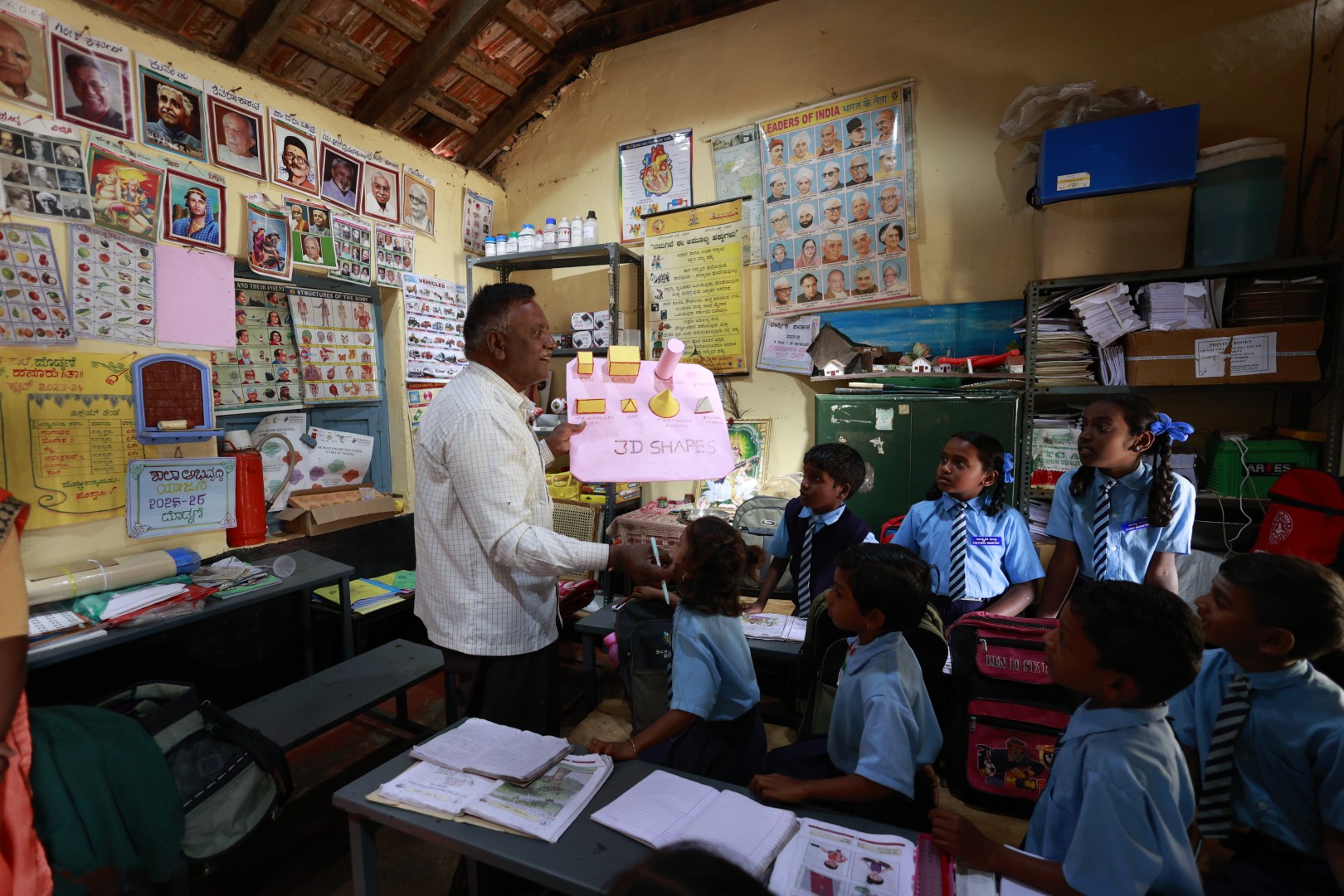
Equitable Education for Rural Communities
Using SVYM's decades of grassroots learning to strengthen public education where it matters most — in Anganwadi centres, government schools, families and communities.
Objective
To improve equitable access to quality education for rural and tribal children by strengthening existing learning environments, supporting educators, addressing practical barriers, and building community ownership around every child's learning.
Equity is not another school. It is helping every school work better for every child.
India's rural public education system is already the primary learning platform for millions of children. EERC begins by asking how that existing system can become more accessible, participatory, contextually relevant and effective in everyday settings.
SVYM brings more than four decades of experience from running schools and learning centres, working inside government schools, supporting teachers, enabling scholarships and higher-education pathways, and partnering with rural and tribal communities. EERC brings those learnings together in one place.
Launched in 2022, the programme works from the foundational stage onwards, responding to barriers such as infrastructure gaps, teacher shortages, language and cultural differences, economic constraints, gender disparities and uneven access to learning opportunities.
The central idea
Do not build a parallel system when the public system can be strengthened.
EERC works with Anganwadi workers, teachers, families, community institutions and government departments so that capability and ownership remain close to the child.
For SVYM, this is part of building the human and social capital — strengthening individual capability while helping communities and institutions take greater responsibility for education.
Being enrolled is only the beginning. Children need to attend, engage, learn and continue.
Solutions are shaped around local barriers, culture, language, infrastructure and the realities of families and educators.
Communities are treated as partners in education, not merely as recipients of an external programme.
Strengthen what already exists. Build what is missing.
EERC is designed around the public system rather than around a stand-alone intervention. The programme looks at the child, the educator, the learning environment, the family and the local institution as parts of one education ecosystem.
Understand the Context
Identify the real barriers to access, attendance, participation and learning in each community instead of assuming that the same solution fits every school.
Support Educators
Strengthen Anganwadi workers and teachers through practical capacity building, learning materials, resource persons and opportunities to learn from effective practice.
Improve the Environment
Address infrastructure and learning-resource gaps, enrich classroom transactions and create opportunities for experiential and contextual learning.
Bring the Community In
Engage parents, local women, volunteers, community institutions and other stakeholders as contributors to children's learning and school participation.
Build Ownership
Move gradually from SVYM-supported demonstration towards local capability, shared responsibility and continuity beyond direct programme support.
The aim is not to replace teachers, Anganwadi workers or government institutions. It is to help the people and structures already closest to children work together with greater capability, confidence and ownership.
Working across the learning continuum
During FY 2025–26, EERC worked across selected rural and tribal geographies in Dharwad and Mysuru districts, from early childhood learning through government schools and continuing education.
Enrolment achieved for 466 children across 44 ECCE centres.
Children across 44 Anganwadi centres engaged with teaching and learning materials.
Learning sessions conducted by 31 resource persons.
Students participated in 11 exposure visits, extending learning beyond the classroom.
Tribal students continuing education in Arts, Commerce, Science and ITI pathways.
Year EERC was launched as a focused effort to make education more equitable across the continuum.
Why there is no year-on-year reach chart here: EERC is still evolving, and the Annual Reports have used different operational footprints and reach measures as programme phases changed. The current page therefore prioritises the latest verified footprint rather than creating a misleading trend line.
Education becomes equitable when the adults around the child become a learning community
A school system cannot be strengthened by infrastructure alone. EERC places equal emphasis on the people who make education work every day — frontline educators, families, communities and public institutions.
Practical support focuses on better classroom transactions, learning materials, resource-person sessions, capacity building and exposure to effective learning environments.
Mothers, grandmothers, local women, parents and community representatives are encouraged to participate as volunteers, problem-solvers and partners in children's learning.
SVYM works with public departments and local officials so that learning improvements are connected to existing institutions rather than sitting outside them.
Community participation in real life
In earlier phases of EERC, farmers shared part of their land with a school so students could carry out farming activities and make science observations. In Hosuru Hadi, the first school-day celebration drew more than 250 people, reflecting growing aspiration among teachers, children and community members.
At Bavali Hadi, after an Anganwadi building became unusable, the community, Forest Department and EERC team worked together to repurpose and refurbish an abandoned forest guard house so children could resume learning in a safer space.
What SVYM has learned
Enrolment alone is not equity. Attendance, participation and learning matter just as much.
Another curriculum is not always the answer. Often the greater need is helping educators transact the existing curriculum more effectively with practical resources and local support.
Ownership has to be designed from the beginning. Communities are more likely to sustain what they have helped understand, shape and build.
From demonstration to a stronger public system
The long-term value of EERC lies not in how long SVYM remains in a village, but in whether stronger practices, relationships and ownership remain after direct support reduces.
The programme therefore follows a simple progression: understand the community → demonstrate what is possible → enable local ownership. SVYM remains a facilitator and learning partner, while teachers, Anganwadi workers, families, community institutions and public systems increasingly carry the work forward.
This direction aligns with SVYM's Education Sector Strategy: strengthen government schools through community engagement, learning resources and teacher capacity; develop community-driven models for foundational learning and skill integration; and build approaches that can be adapted and scaled without losing contextual relevance.
The larger opportunity
India already has a vast public education infrastructure. The challenge is to ensure that geography, poverty, gender, disability, language or social background do not determine the quality of opportunity available to a child.
EERC is SVYM's attempt to translate decades of grassroots learning into approaches that strengthen that system from within — one community, one educator and one learning environment at a time.
Invest in teachers, Anganwadi workers and local resource people who shape the child's everyday learning experience.
Create meaningful roles for families and local institutions so education becomes a shared responsibility.
Document, refine and adapt approaches that can strengthen public education in other underserved geographies.
Strengthen the system around every child.
Partner with SVYM to make public education more accessible, participatory and equitable — by investing in educators, learning environments, community ownership and pathways that help children continue to learn.