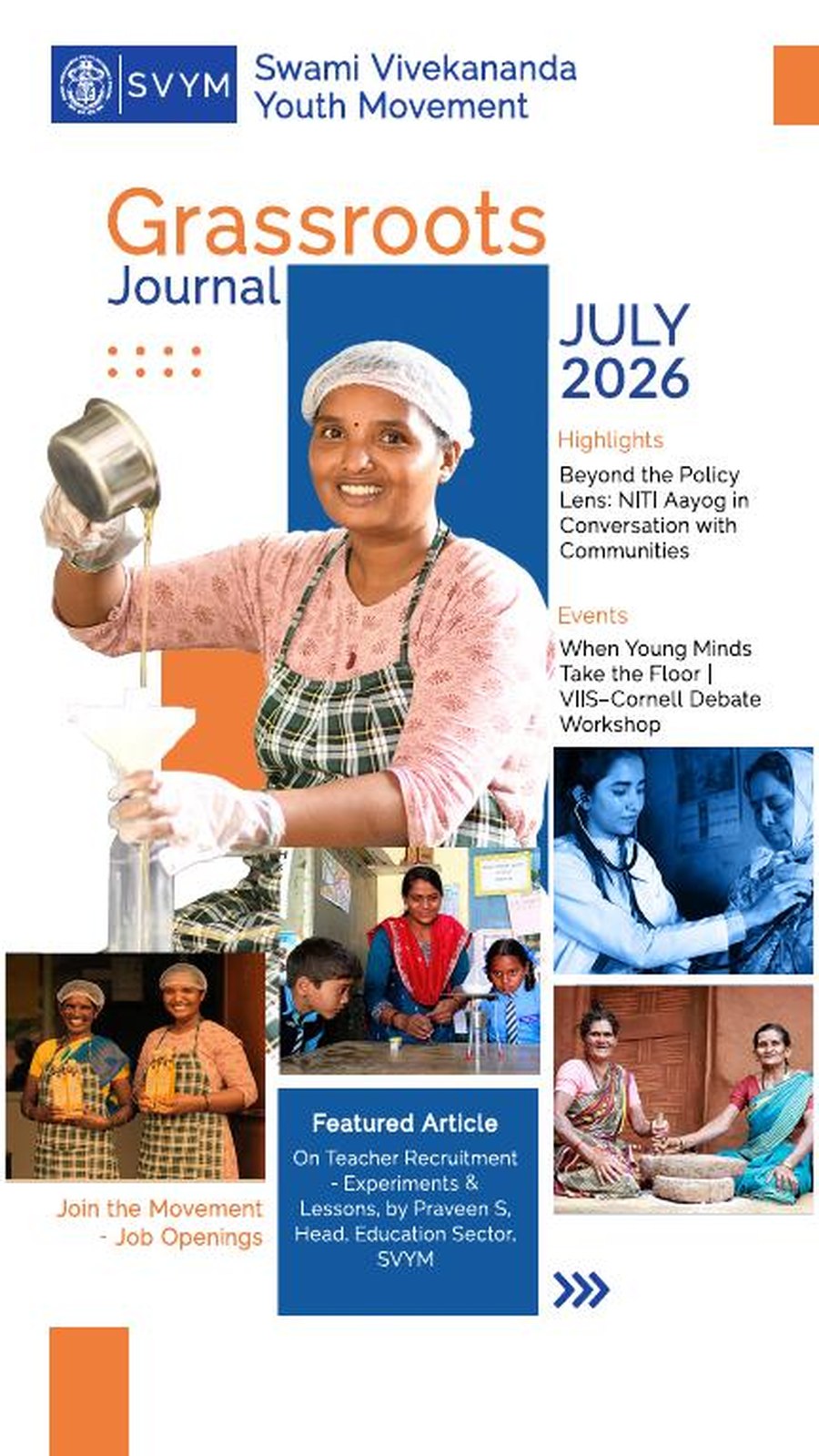
Grassroots Journal — July 2026
On Teacher Recruitment – Experiments & Lessons
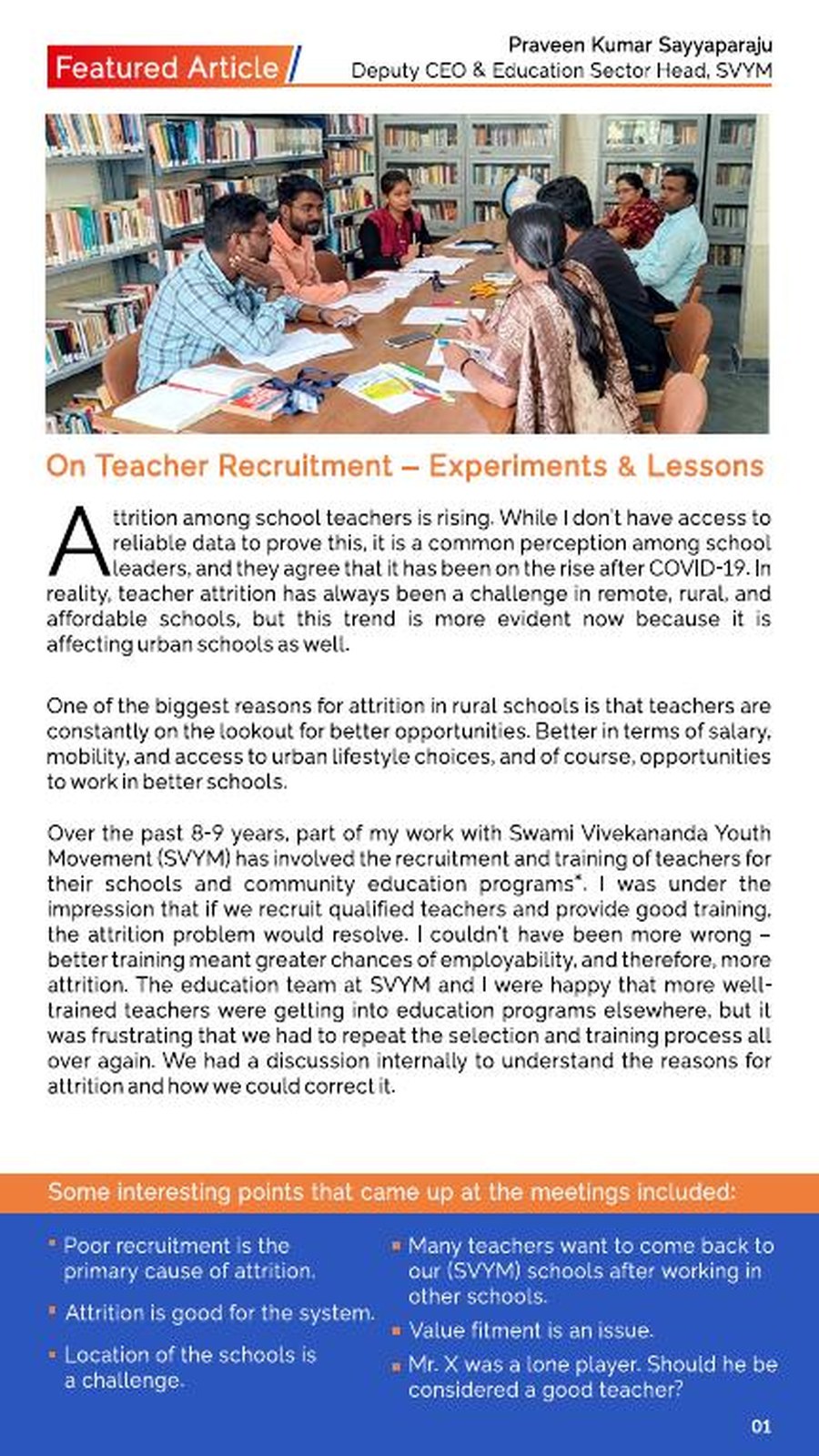
Attrition among school teachers is rising. While I don’t have access to reliable data to prove this, it is a common observation among school leaders, and they agree that it has been on the rise after COVID-19. In reality, teacher attrition has always been a challenge in remote, rural, and affordable schools, but this trend is more evident now because it is affecting urban schools as well.
One of the biggest reasons for attrition in rural schools is that teachers are constantly on the lookout for better opportunities. Better in terms of salary, mobility, and access to urban lifestyle choices, and of course, opportunities to work in better schools.
Over the past 8–9 years, part of my work with Swami Vivekananda Youth Movement (SVYM) has involved the recruitment and training of teachers for their schools and community education programmes. I was under the impression that if we recruit qualified teachers and provide good training, the attrition problem would resolve. I could not have been more wrong—this training went over the heads of comparatively, and therefore, more experienced. Nevertheless, there were always a handful who were trained teachers were getting into education programmes elsewhere, but it was frustrating that we had to respond to the selection and training process all over again. We had a discussion recently to understand the reasons for attrition and how we could correct it.
Some interesting points that came up at the meetings included:
- Poor recruitment is the primary cause of attrition.
- Attrition is good for the system.
- Location of the schools is a challenge.
- Many teachers want to come back to their city/schools after working in other schools.
- Attrition is an issue.
- Mr. X was a lone player. Should he be considered a good teacher?
When we picked specific examples to discuss in detail, I could feel a sense of loss among the senior teachers of our institutions who had selected the new recruits. This sense of ownership among the seniors was a good thing.
Our data also showed that a teacher who worked with us for a year would go on to be with us for at least five years, unless they were forced to relocate because of marriage or other family commitments.
Two other aspects that we identified based on our internal data were:
- An interim recruitment (during the academic year) didn’t result in a long-term hire. Teachers recruited at the start of the academic year had an opportunity to be inducted into the system over two–three weeks before classes began. This wasn’t possible with interim recruits.
- There seemed to be some connection between the interview panellists and the longevity of a teacher in the system although the data didn’t show a strong relationship.
While analysing on a case-to-case basis, it was also interesting to note that the teachers who stayed with us longer were the ones who were given the freedom to experiment or were given additional responsibilities, time and space. This prompted us to review and improve our recruitment processes.
Our recruitment process now involves a demo class followed by an interview. The interviews mostly focused on the location, accommodation and salary aspects.
First, we shared a presentation about the basic aspects with all candidates as they walked in. All information, including designations and salary scales, was worked out in advance and presented. This transparency, along with valuable time, helped us focus on issues/aspects that really mattered.
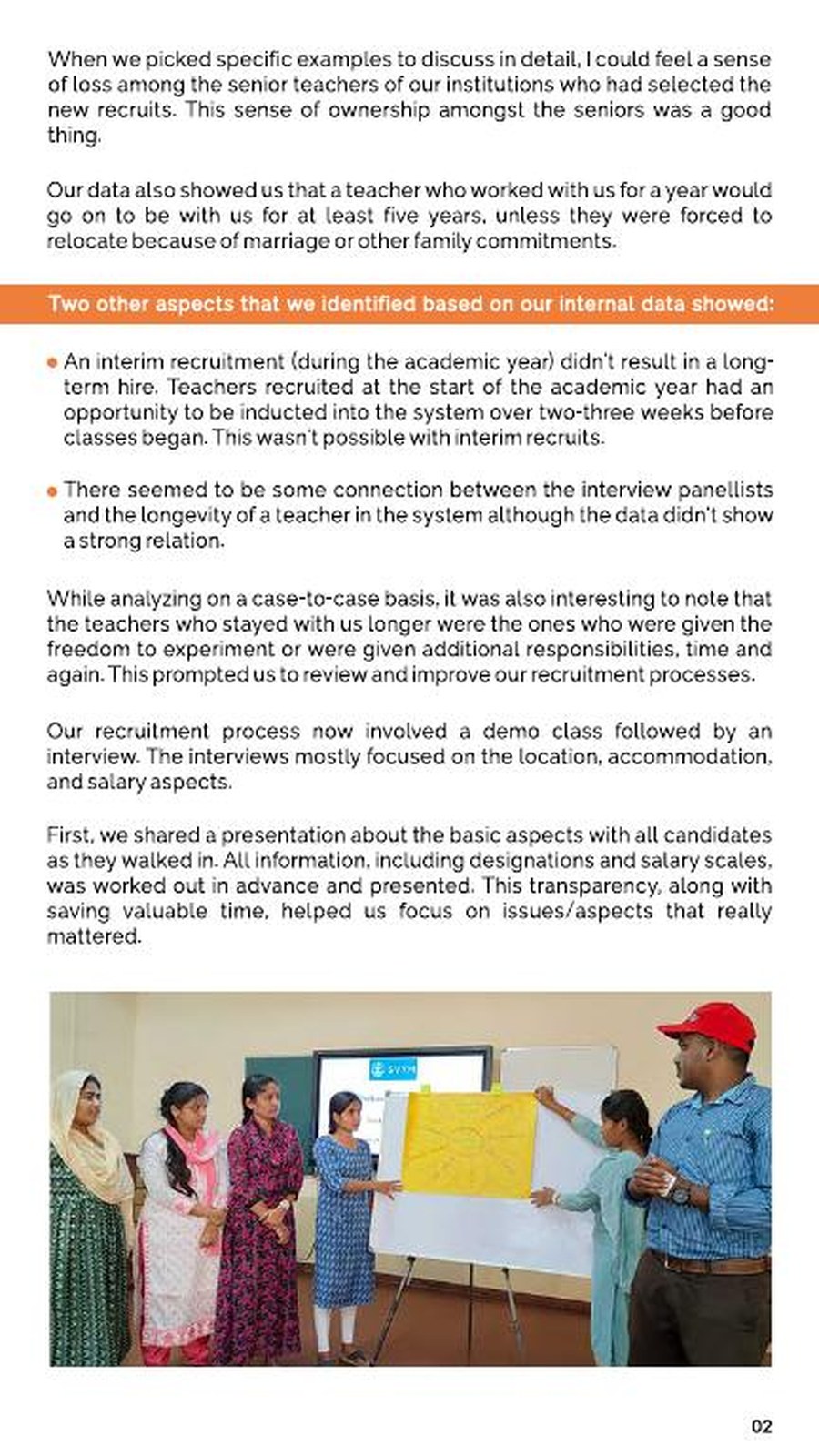
Most teachers tend to do well in demo classes as they would have rehearsed sufficiently; also, we can’t really test their subject knowledge in a 15-minute demo class. For us, it mattered more whether a teacher was a team player or not than whether a teacher was excellent at their subject.
So, we replaced the demo classes with group activities, where the candidates were observed for their ability to communicate effectively and work in teams.
Lastly, the interviews were focused on sharing ideas on education and learning about the teachers and how they planned to approach teaching. With these three key changes, the selection process moved away from knowledge and skills to focus on the attitude of the teachers.
While we haven’t been able to bring down attrition to desirable levels, our teachers’ group is much more vibrant today. Our current recruitment system is more time-consuming than the conventional method, but it is a worthwhile exercise considering the fact that we are selecting our own teachers and our children’s teachers.
SVYM runs three institutions, including a tribal school for the indigenous tribal communities of the Bandipur–Nagarahole National Parks. The institutions aim to be accessible to quality and contextually relevant education to underserved communities. All the institutions are located in the rural and tribal areas of the Mysuru District of Karnataka.
The community-based education programmes take the learnings from SVYM institutions to schools run by the government, focusing on creating a conducive learning environment for children, promoting community participation and building teacher capacities. Cumulatively, these programmes reach over 45,000 students annually.
↑ Back to topWhen Policy Meets Practice: NITI Aayog Members Visit SVYM
For over four decades, SVYM has worked alongside tribal and rural communities in H.D. Kote, learning from them while building programmes that respond to their aspirations and realities. This five-day visit by Dr. R. Balasubramaniam and Dr. Aniya Joram, Full-Time Members of NITI Aayog, joined by Shri Ganesan Nagarajan, Deputy Secretary, Ministry of Tribal Affairs (MoTA), and SVYM’s leadership.
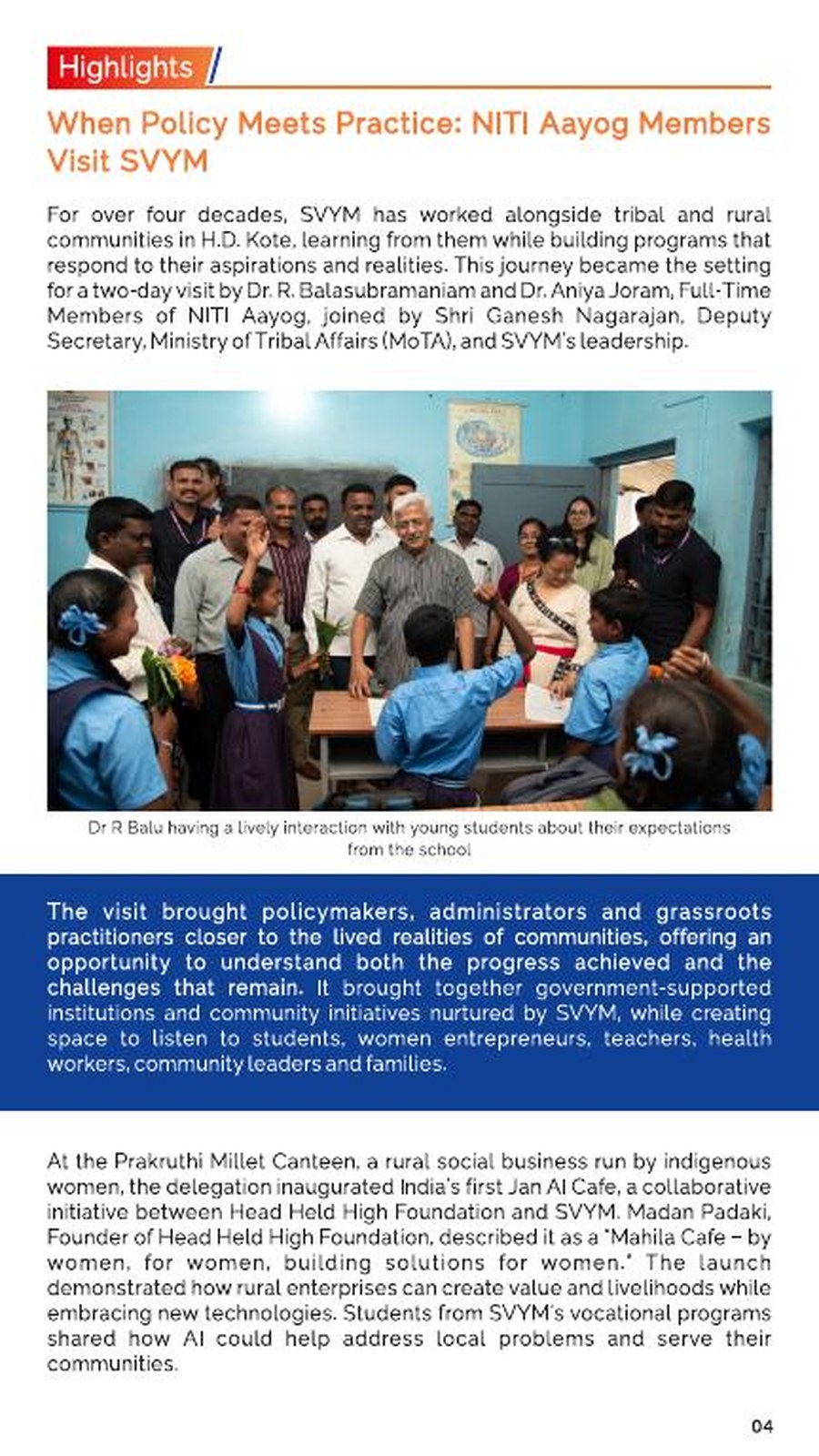
At the Prakruthi Millet Canteen, a rural social business run by indigenous women, the delegation inaugurated India’s first Jan A Café, a collaborative initiative between Head Held High Foundation and SVYM. Madan Padaki, Founder of Head Held High Foundation, described it as a “Malaria Café” by women for women. For women, building solutions for and from the community demonstrated how rural enterprises can create value and livelihoods while embracing new technologies.
At the Eklavya Model Residential School in Sollepura, Dr. R. Balu recalled the advocacy, including efforts that helped secure land for the school. He interacted with students and visited the hostel and dining facilities. At Viveka Tribal Centre for Learning (VTCL), community members shared their aspirations and concerns with representatives from NITI Aayog. The delegation also met a Self-Help Group formed over 20 years ago and discussed forest resources, livelihoods and public services.
The visit also included Jandhanwadi Community Radio, which reaches nearly 2.7 lakh people across the region, and an interaction at V-LEAD. The two-day visit created a space for representatives from SVYM’s institutional journey and policy efforts to connect, reflecting on community-led work and the role of lived experience in strengthening public policy.
↑ Back to topGenNext-Kausalyan: A Skilling Initiative Gaining Momentum
The GenNext-Kausalyan initiative is focused on helping young people build the skills, confidence and capabilities they need to access meaningful employment opportunities.
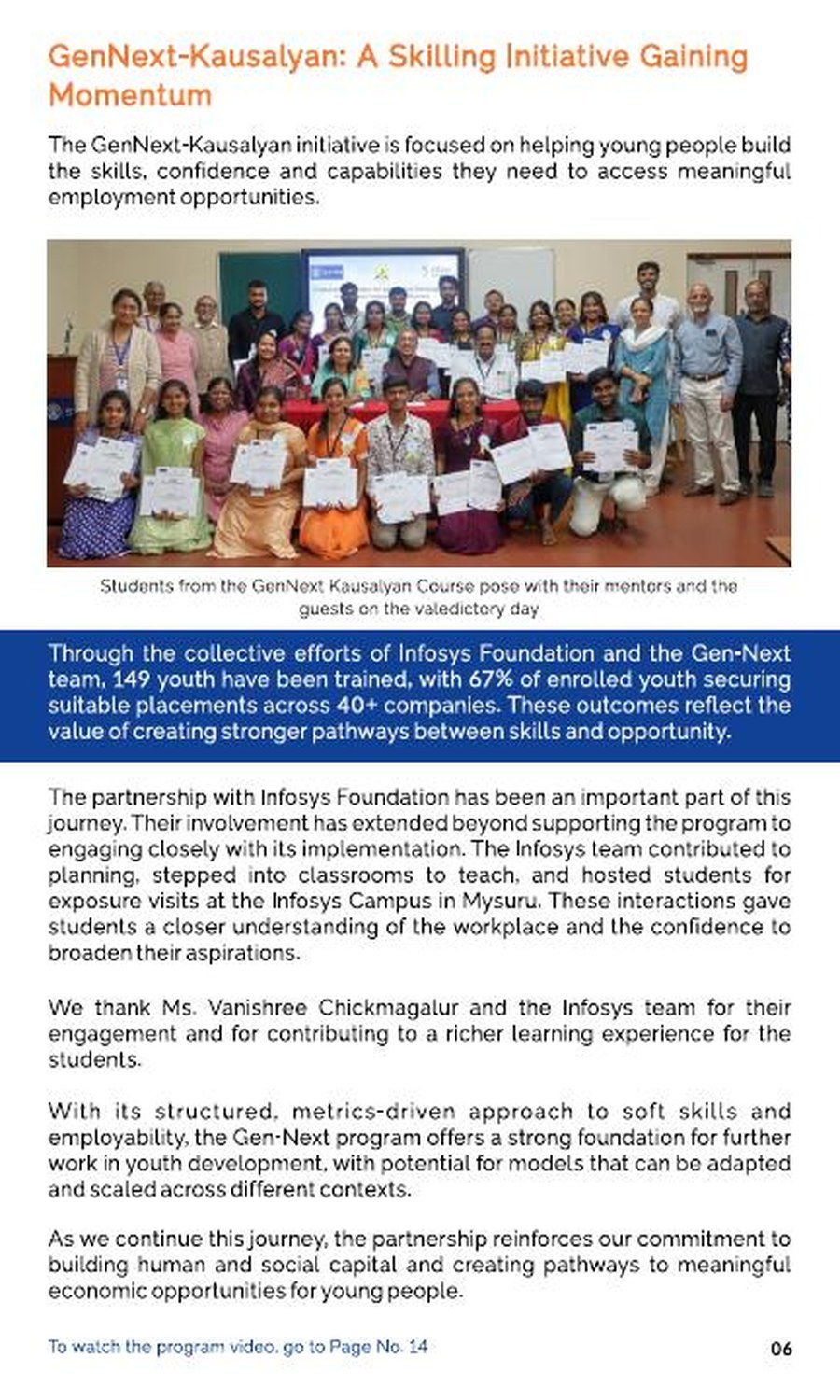
The partnership with Infosys Foundation has been an important part of this journey. Their involvement has extended beyond supporting the programme to engaging closely with its implementation. The Infosys team contributed to planning, stepped into classrooms to teach, and hosted students for exposure visits at the Infosys Campus in Mysuru.
We thank Ms. Vanishree Chickmagalur and the Infosys team for their engagement and for contributing to a richer learning experience for the students.
With its structured, metrics-driven approach to soft skills and employability, the GenNext program offers a strong foundation for further work in youth development, with potential for models that can be adapted and scaled.
As we continue this journey, the partnership reinforces our commitment to building human and social capital and creating pathways to meaningful economic opportunity for young people.
↑ Back to topWorld Youth Skills Day: Turning Skills into Opportunity
World Youth Skills Day was marked by recognising the achievements of youth, women and farmers trained through SVYM’s Viveka Rural Livelihood Centres across Karnataka.
The average monthly income following vocational training is around ₹30,000 for agriculture-related activities, and ₹15,000–18,000 for courses such as General Duty Assistant, Mobile Repair Training, Beautician and Fashion Designing Courses.
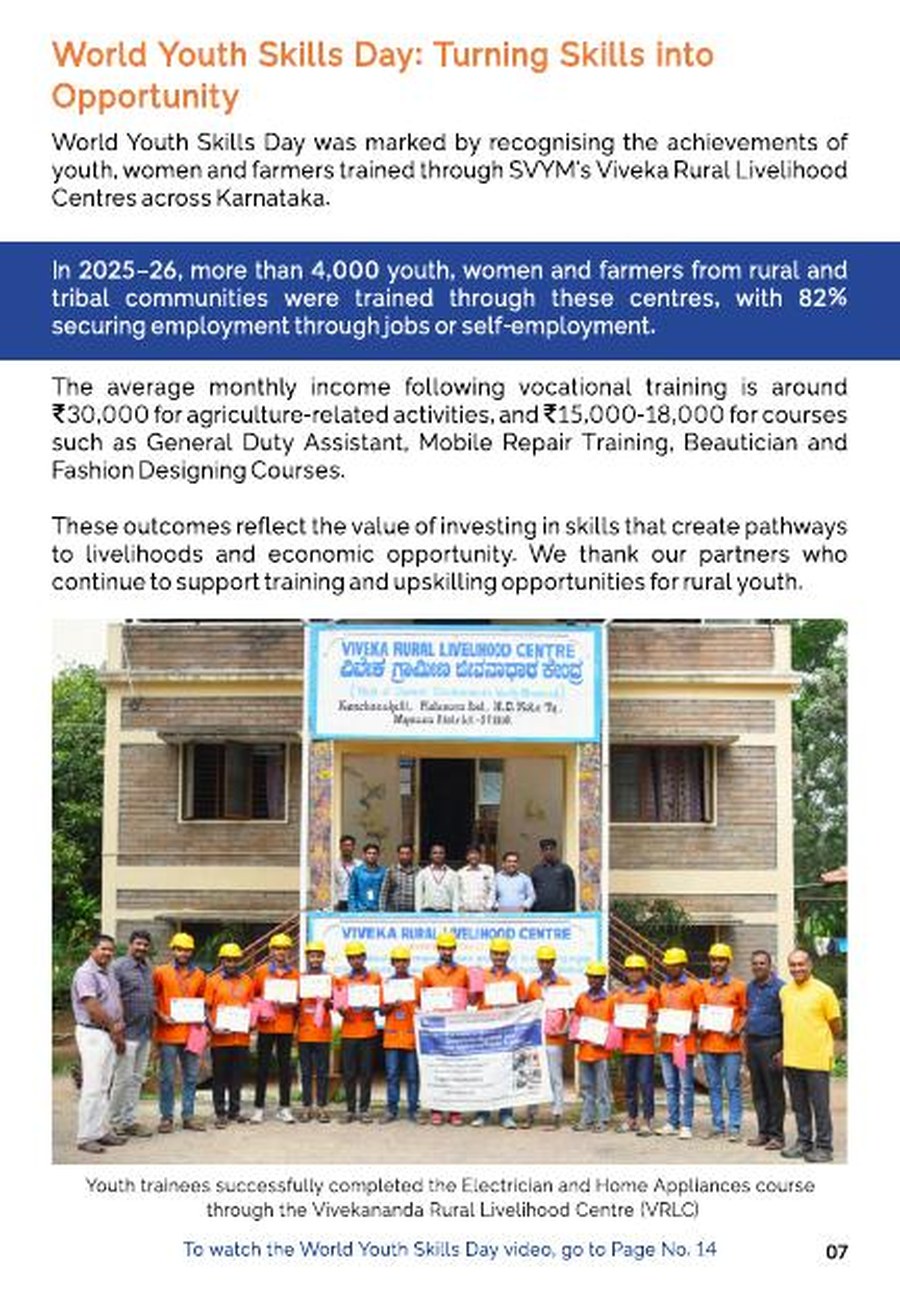
These outcomes reflect the value of investing in skills that create pathways to livelihoods and economic opportunity. We thank our partners who continue to support training and upskilling opportunities for rural youth.
↑ Back to topA Learning Visit to Institute of Palliative Medicine
The Palliative Care team at SVYM recently visited the Institute of Palliative Medicine (IPM), Kozhikode, to learn from its community-based palliative care model.
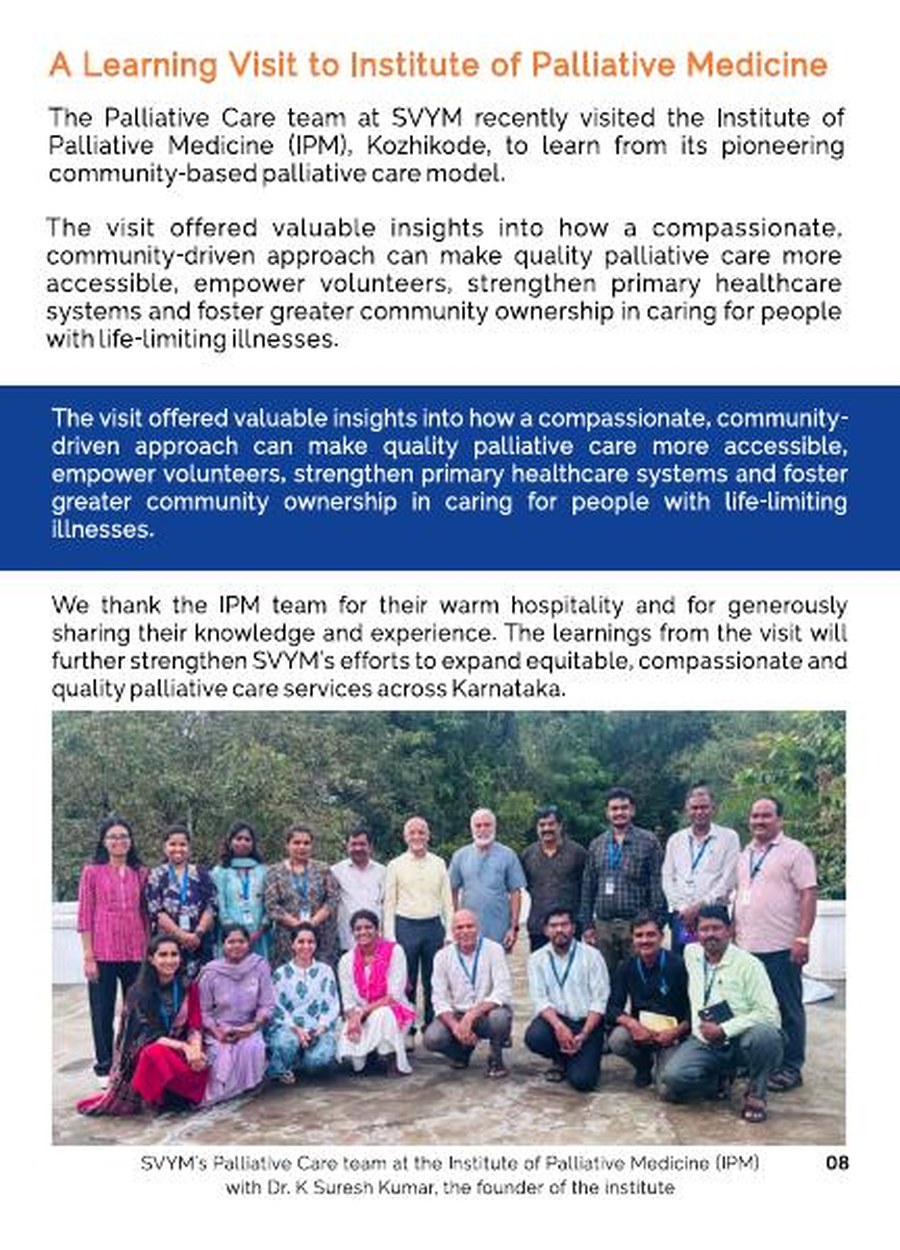
We thank the IPM team for their warm hospitality and for generously sharing their knowledge and experience. The learnings from the visit will further strengthen SVYM’s efforts to expand equitable, compassionate and quality palliative care services across Karnataka.
↑ Back to topA New Chapter in Community-Based Rehabilitation
In partnership with Nayana Energy Limited, SVYM marked an important milestone under Project SMART H with the inauguration of Community-Based Rehabilitation (CBR) services across Mysuru and Kodagu districts. The event brought together government representatives, CSR partners, disability federations and community institutions.
The event also marked the launch of ‘Vishesha’, a brand of products developed by Federations of Persons with Disabilities, including rice and ragi flour, paper bags and incense sticks. The initiative seeks to strengthen livelihood opportunities and market linkages through collective enterprises.
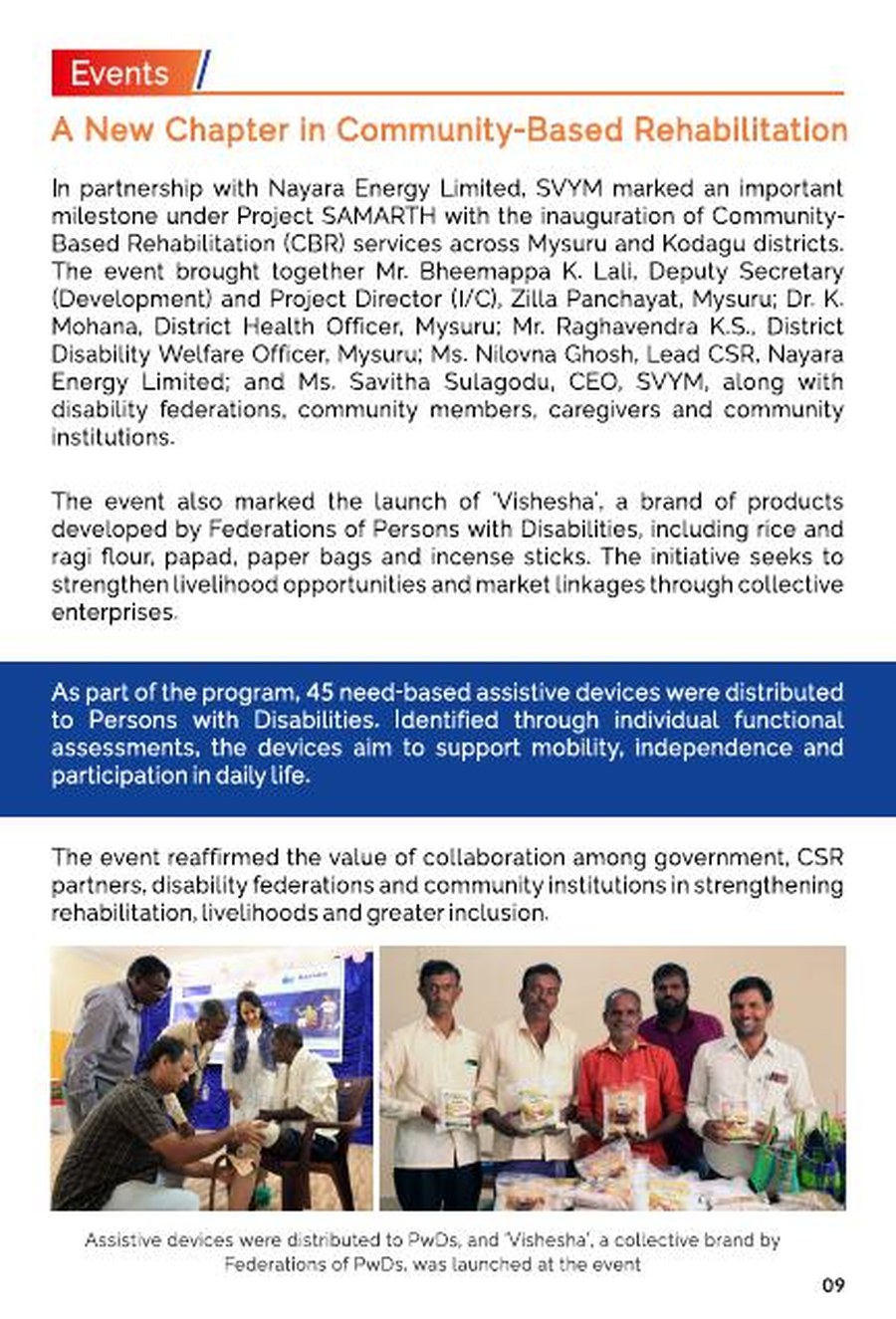
The event reaffirmed the value of collaboration among government, CSR partners, disability federations and community institutions in strengthening rehabilitation, livelihoods and greater inclusion.
↑ Back to top‘Reflections on Swami Vivekananda’: Book Launch
At SVYM, the life and message of Swami Vivekananda have long inspired our work in service, institution-building and community action. Reflections on Swami Vivekananda is another step in that journey.
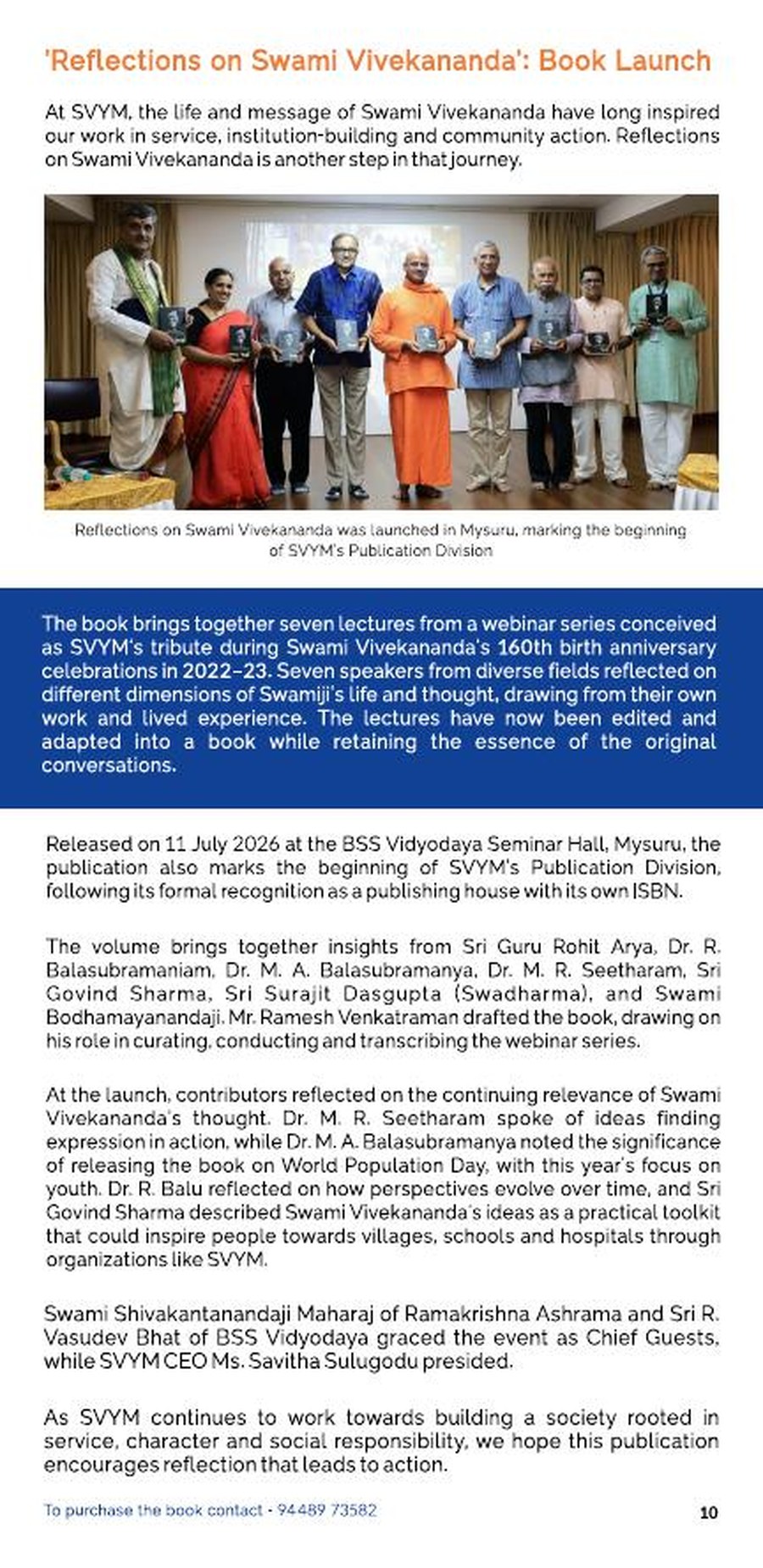
Released on 11 July 2026 at the BSS Vidyodaya Seminar Hall, Mysuru, the publication also marks the beginning of SVYM’s Publication Division, following its formal recognition as a publishing house with its own ISBN.
The volume brings together insights from Sri Guru Rohit Arya, Dr. R. Balasubramaniam, Dr. M. A. Balasubramanya, Dr. M. R. Seetharam, Dr. Govind Sharma, Sri Surajit Dasgupta (Swadharma), and Swami Bodhamayananda. Mr. Ramesh Venkatraman drafted the book, drawing on his role in curating, conducting and transcribing the webinar series.
At the launch, contributors reflected on the continuing relevance of Swami Vivekananda’s thought. Dr. M. R. Seetharam spoke of ideas finding expression in action, while Dr. M. A. Balasubramanya noted the significance of releasing the book on World Population Day, with this year’s focus on youth. Dr. R. Balu reflected on how perspectives evolve over time, and Sri Govind Sharma described Swami Vivekananda’s ideas as a practical toolkit that could inspire people towards villages, schools and hospitals through organisations like SVYM.
Swami Shivanandanandaji Maharaj of Ramakrishna Ashrama and Sri R. Vasudev Bhat of BSS Vidyodaya graced the event as Chief Guests, while SVYM CEO Ms. Savitha Sulugodu presided.
As SVYM continues to work towards building a society rooted in service, character and social responsibility, we hope this publication encourages reflection that leads to action.
To purchase the book, contact: 94489 73582
↑ Back to topKargil Vijay Diwas: Lessons in Courage and Leadership
On Kargil Vijay Diwas, Viveka Sainik School hosted Group Captain Naval Saini, an Indian Air Force veteran who served in strategic operations across Leh and Ladakh and has served decades with the Air Force Selection Boards.
As part of the school’s tradition, a war veteran is invited each year to share experiences of courage and service with the students. Group Captain Saini spoke about his experiences during the Kargil War, sharing lessons on leadership, resilience and patriotism.
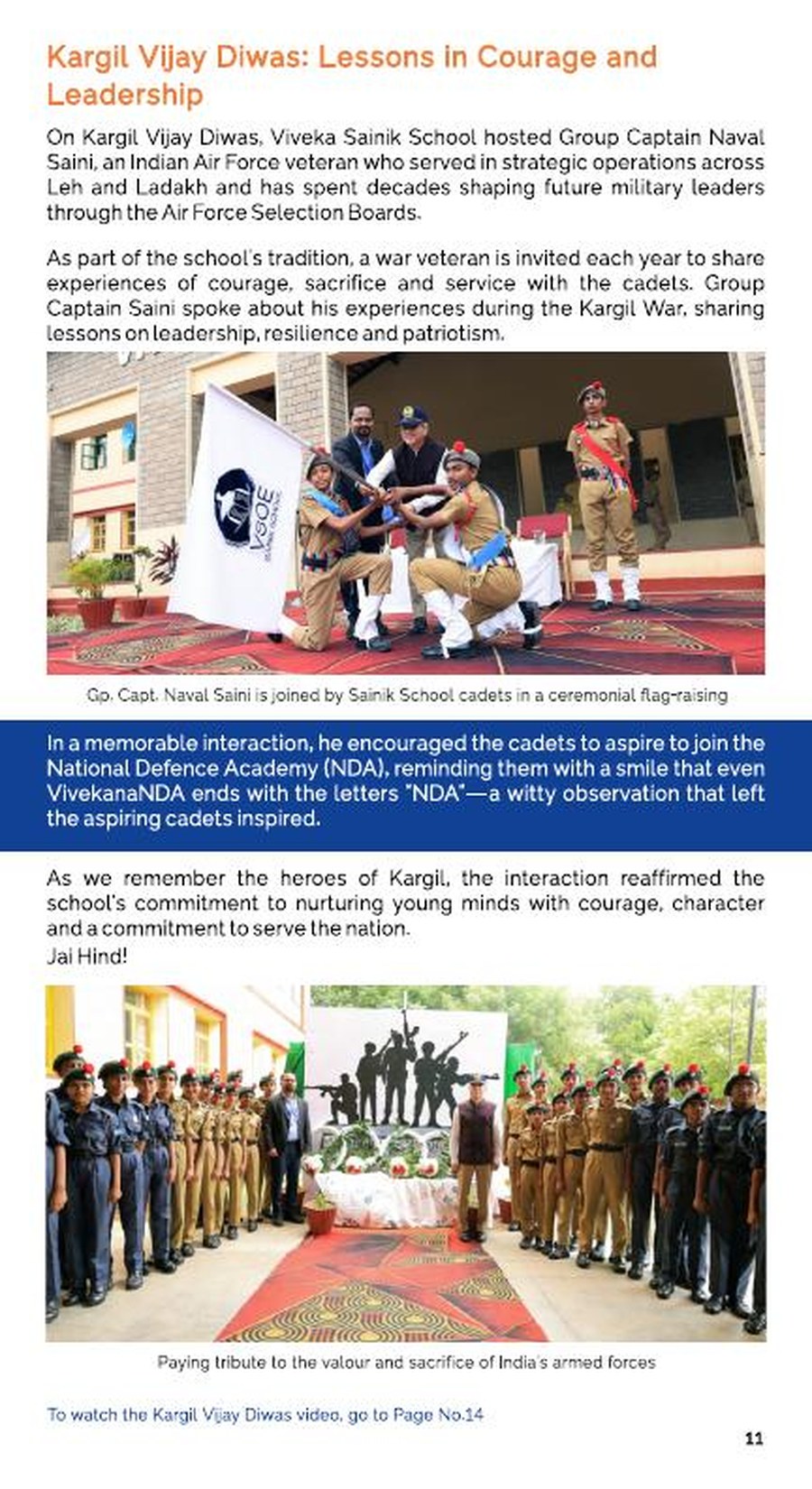
As we remember the heroes of Kargil, the interaction reaffirmed the school’s commitment to nurturing young minds with courage, character and a commitment to serve the nation.
↑ Back to topVIIS–Cornell University Workshop: Learning the Art of Debate
Vivekananda Institute of Indian Studies (VIIS) hosted a three-day Argumentation and Debate Workshop from 2–4 July 2026 at V-LEAD, Mysuru, in collaboration with ILR School, Cornell University, USA. The workshop brought together 32 students from schools across Mysuru, Hosur and Bengaluru, including students from Viveka School of Excellence and Manjula School.
The Speech and Debate program at Cornell University brings together faculty and staff with more than 60 years of combined teaching and coaching experience. VIIS has partnered with Cornell University for 14 years through its Global Service Learning programme at SVYM.
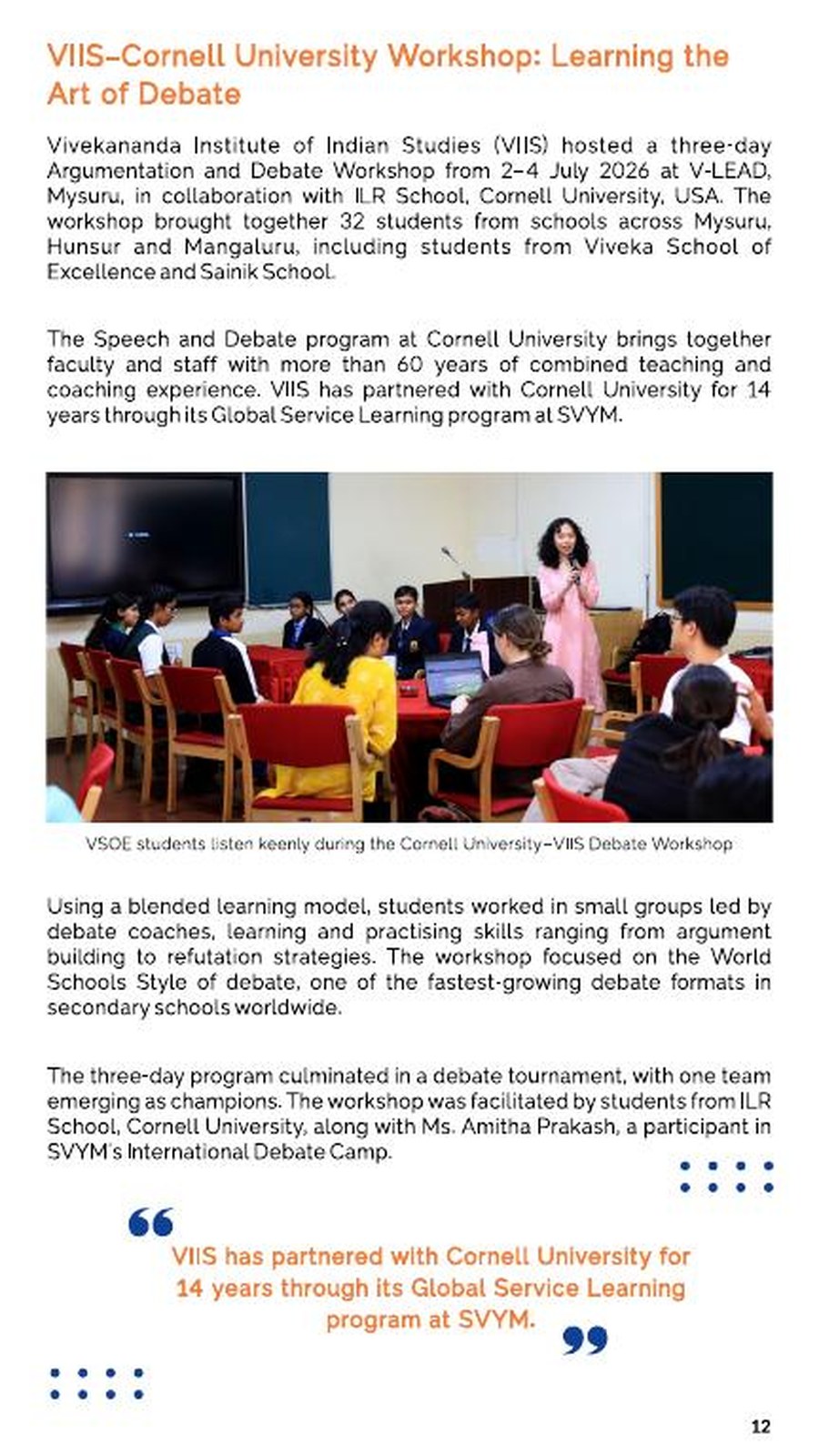
Using a blended learning model, students worked in small groups led by debate coaches, learning and practising skills ranging from argument building to refutation strategies. The workshop focused on the World Schools Style of debate, one of the fastest-growing debate formats in secondary schools worldwide.
The three-day programme culminated in a debate tournament, with one team emerging as champions. The workshop was facilitated by students from ILR School, Cornell University, along with Ms. Amitha Prakash, a participant in SVYM’s International Debate Camp.
Donor Partnerships
Essaе Padmaaruna Trust
Continuing our shared commitment to the holistic education and development of 50 rural and tribal students at Viveka Tribal Centre for Learning (VTCL).
Qualcomm India Pvt Ltd
Furthering our partnership through the AQRITI STEM Education Program to provide STEM education to children, with a special focus on girls, across Mysuru, Kallaburagi, Chikkaballapur, Kolar and Dharwad. The partnership also supports meritorious girls from economically disadvantaged backgrounds through scholarships for Classes 11 and 12 and higher education.
ICATCH
Partnering to strengthen early detection and community-based intervention for developmental disabilities through the High Risk Baby Program in Saragur and H.D. Kote. The partnership will support high-risk babies, children with developmental disabilities and early cerebral palsy, and healthcare professionals and workers.
Kotak Mahindra Prime Limited
Partnering to strengthen access, school participation and learning outcomes among students from forest-based tribal communities through a Hub and Spoke Model of School Complexes.
Sightsavers India
Partnering through the Amrita Drishti Urban Eye Health Program to strengthen access to eye health services in Bengaluru, in collaboration with health workers at H Siddaiah Road Referral Hospital, ASHA workers and community leaders.
Wone Creations Private Limited
Partnering to support the Future Teacher-Leaders of India (FTLI), a three-month residential fellowship program for 2026–27, aimed at strengthening teacher leadership across Karnataka in collaboration with teacher training institutions, teachers, school leaders and government education institutions.
Titan Company Limited
Partnering to support higher education and career pathways for students from underserved communities through the Viveka Scholar Program, Viveka Chetana Program and Continuous Education for tribal students. The programs support higher education, STEM-focused careers for talented girls from across Karnataka, and higher education for students of Viveka Tribal Centre for Learning (VTCL).
Srirangamma Rangachar, Chelur – Endowment Fund
Established by Dr. T. A. Veena in memory of her mother-in-law, the fund supports SVYM’s Palliative Care program to provide comprehensive home-based and institutional care for people living with serious, life-limiting illnesses.
Kaynes Technology India Limited
Partnering to support SVYM’s palliative care program through comprehensive home-based and institutional care, along with medical equipment and assistive medical devices for patients. The partnership will also support patients and caregivers in collaboration with healthcare providers.
Aurigene Pharmaceutical Services Ltd.
Partnering to strengthen education and healthcare access in rural and tribal communities through the EERC project and Mobile Health Unit (MHU). The continuing EERC partnership strengthens school participation and learning outcomes, while the MHU supports essential healthcare services for over 12,000 tribal community members in H.D. Kote and Saragur taluks.
Ms. Jayashree Rao Endowment in Memory of Surya Satyasree M Rao
Established in memory of Surya Satyasree M Rao, the endowment will recognise a girl student who demonstrates academic merit and human values in every academic year. The award will be presented at the end of her final year.
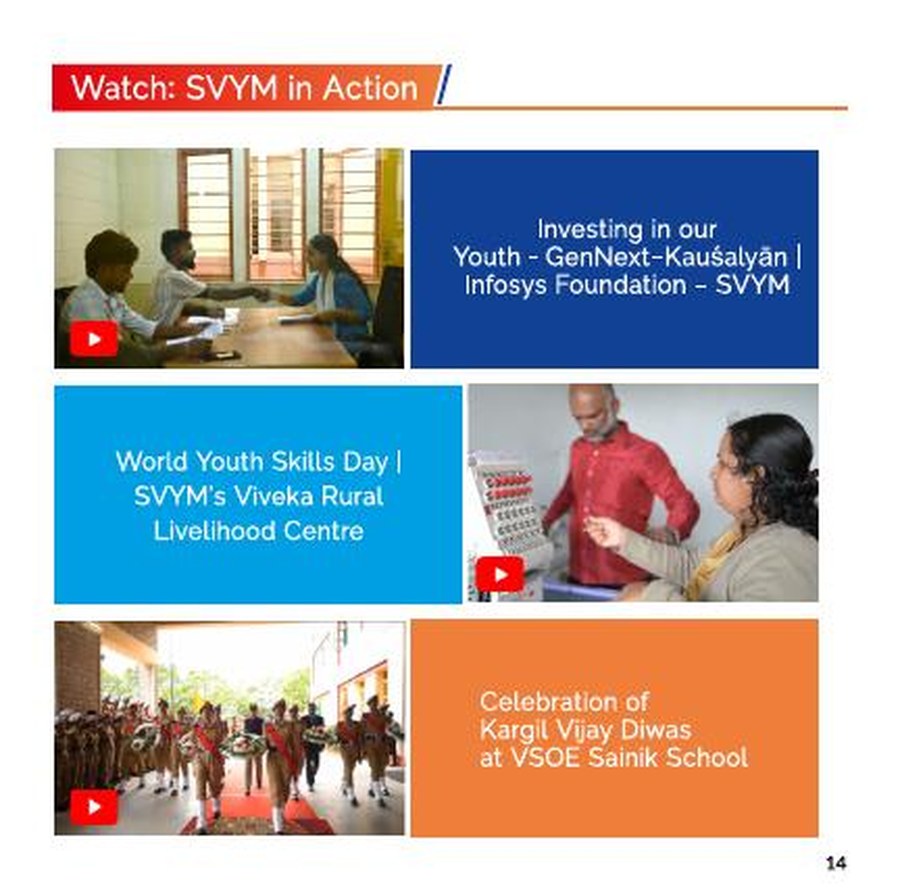
SVYM in Action
Investing in our Youth – GenNext-Kausalyan | Infosys Foundation – SVYM
Explore the GenNext-Kausalyan skilling initiative and its focus on youth employability.
World Youth Skills Day | SVYM’s Viveka Rural Livelihood Centre
Stories from vocational training and livelihood pathways.
Celebration of Kargil Vijay Diwas at VSOE Sainik School
Watch the school’s observance and interactions with a war veteran.
Job Openings
| Position | No. of Vacancies | Sector | Department | Qualification | Location |
|---|---|---|---|---|---|
| Rehab Resource Coordinator | 1 | Health | CCST | Any Graduate | Virajpet |
| Project Facilitator | 1 | Health | CCST | Any Graduate | Virajpet |
| Pharmacist | 1 | Health | Pharmacy | Diploma in Pharmacy | Saragur |
| Pharmacist | 1 | Health | Palliative Care | Diploma in Pharmacy | Mysuru |
| Lab Technician | 1 | Health | Research | DMLT | Saragur |
| Facilitator – Health | 2 | Health | Research | PUC | Saragur |
| District Project Coordinator | 1 | Health | CF TB Project | MSW/MA Sociology/MSC Sociology with 3 years of relevant work experience | Bidar |
| District Project Manager | 1 | Health | CF TB Project | MSW/MA Sociology/MSC Sociology with 5 years of relevant work experience | Turnkur |
| Asst. Physiotherapist | 1 | Health | LAB – VMH | DMLT | Saragur |
| Officer – Marketing & Public Relationship | 1 | Health | VMH | Any Post Graduate/MSW/MDM | Saragur |
| Communication | 1 | Education | VTCL | Any Graduate | Hoshahalli |
| STEM Lab Facilitator | 1 | Education | School Education Program | BSc/MSc with BEd | Dharwad |
| Facilitator – Computer | 2 | Education | School Education Program | Any Graduate/PGDCA | Kolar & Bangarapet |
| Facilitator – Computer | 1 | Education | School Education Program | Any Graduate/PGDCA | Gauribidanur |
| Facilitator – School | 1 | Education | School Education Program | BA/MA, BSc/MSc with BEd | Dharwad |
| Facilitator – School | 1 | Education | Viveka Scholar Program | Any Graduate | Dharwad |
| Facilitator – School | 1 | Education | EERC | BA/MA, BSc/MSc with BEd | B. Malkotare |
| Senior Facilitator – Documentation Officer | 1 | Education | School Education Program | Any graduate with 1–2 years of work experience | Dharwad/Mysuru |
| Associate | 2 | Education | Nurseries of Talent | BSc/MSc with BEd | Saragur |
| Camp Coordinator | 1 | Education | Nurseries of Talent | Any graduate (B.Ed optional with 0–2 years of work experience) | Saragur |
| Field Mobilizer | 1 | SEEP | SEEP | Any Graduate | Konchanahalli |
| Training Coordinator | 1 | SEEP | SEEP | Any graduate with experience | Ranjankur (Raichur) |
| Community Facilitator | 2 | SEEP | SEEP | Any graduate | Saidapur (Yadgir) |
| Accountant | 2 | OMA | Accounts & Finance | BCom/MBA | Bengaluru & Mysuru |
| Driver | 1 | OMA | Transport | SSLC/7th std | Saragur |
| Coordinator – Admin | 1 | OMA | Purchase | Any Graduate | Mysuru |
| Coordinator – Purchase | 1 | OMA | Purchase | Any Graduate | Mysuru |
| Officer – Marketing & Public Relationship | 2 | OMA | RMT | Any Post Graduate/MSW/MA (Sociology)/MCom | Mysuru |
| Communication | 1 | T&R | Research | BSc/MSW/MA with experience | Mysuru |
| Officer – Promotion & Placement | 1 | T&R | GenNext | Any Graduate | Mysuru |
| Training Coordinator | 2 | T&R | T&R | Any graduate | Mysuru |
| Training Officer | 1 | T&R | T&R | Any graduate with experience | Mysuru |
Send your resume to jobs@svym.org.in
Subscribe to our Monthly Journal
And stay up to date with what’s happening at SVYM.
Click to subscribeSupport Community-Led Change
Support options
INR 1,500 towards medical care for a poor patient of Vivekananda Memorial Hospital.
INR 16,000 towards the cost of providing one person with Palliative Care for a year.
INR 46,000 to support residential education for one tribal child at VTCL for 1 year.
Donate towards other development activities of SVYM.
For donors in India
The Vivekananda Youth Movement may be sent in the name of “Swami Vivekananda Youth Movement” to our official account. The journal page contains the SVYM bank and donation details.
Donations made to SVYM in India are exempt from Income Tax under Sec. 80(G).
For donors in USA
SVYM is a registered 501(c)(3) organisation. Your donations are tax-deductible to the extent allowed by law.
For donors in United Kingdom
Donations to SVYM UK are tax-deductible. UK registered charity number: 1118678.
through our easy and secure payment modes — Netbanking | Credit Card | UPI
Donate Online