
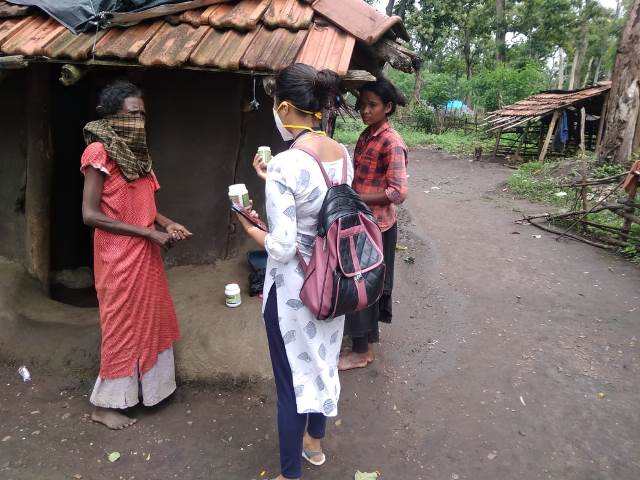
Ending AIDS requires more than one pathway to care.
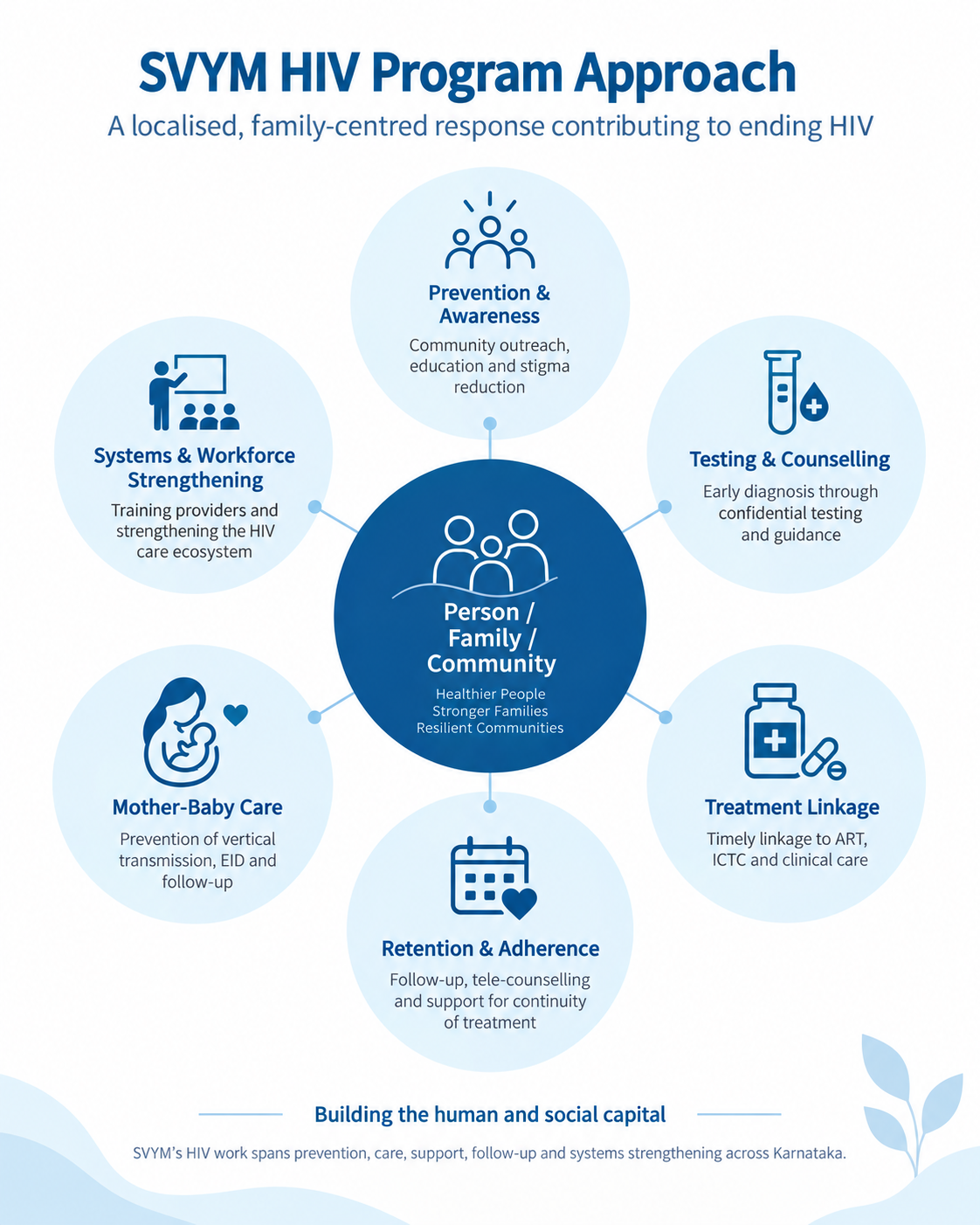
SVYM's HIV Prevention & Control work combines community outreach, counselling, testing, treatment linkage, prevention of vertical transmission, care for high-risk and vulnerable populations, statewide care-and-support networks and workforce development — contributing to the national goal of ending AIDS by 2030.
Objective
To prevent new HIV infections, strengthen timely diagnosis and treatment, improve retention and viral suppression, prevent vertical transmission, reduce stigma and discrimination, and build the capabilities of communities and health-service providers to sustain a responsive HIV care continuum.
A family-centred HIV response that has grown from the last mile to statewide systems
SVYM began its HIV care and control work in 1999. Over time, the programme evolved from institution- and community-based services around Vivekananda Memorial Hospital into large-scale partnerships spanning all 31 districts of Karnataka.
The approach has remained contextual. Different populations face different barriers: a pregnant woman may fear disclosure to her family; a migrant worker may move before completing follow-up; a prison inmate may be transferred or released before confirmatory testing; a person living with HIV may stop ART because of stigma, distance or treatment fatigue. SVYM's model adapts the pathway without compromising clinical standards or confidentiality.
Read more about SVYM's HIV care model
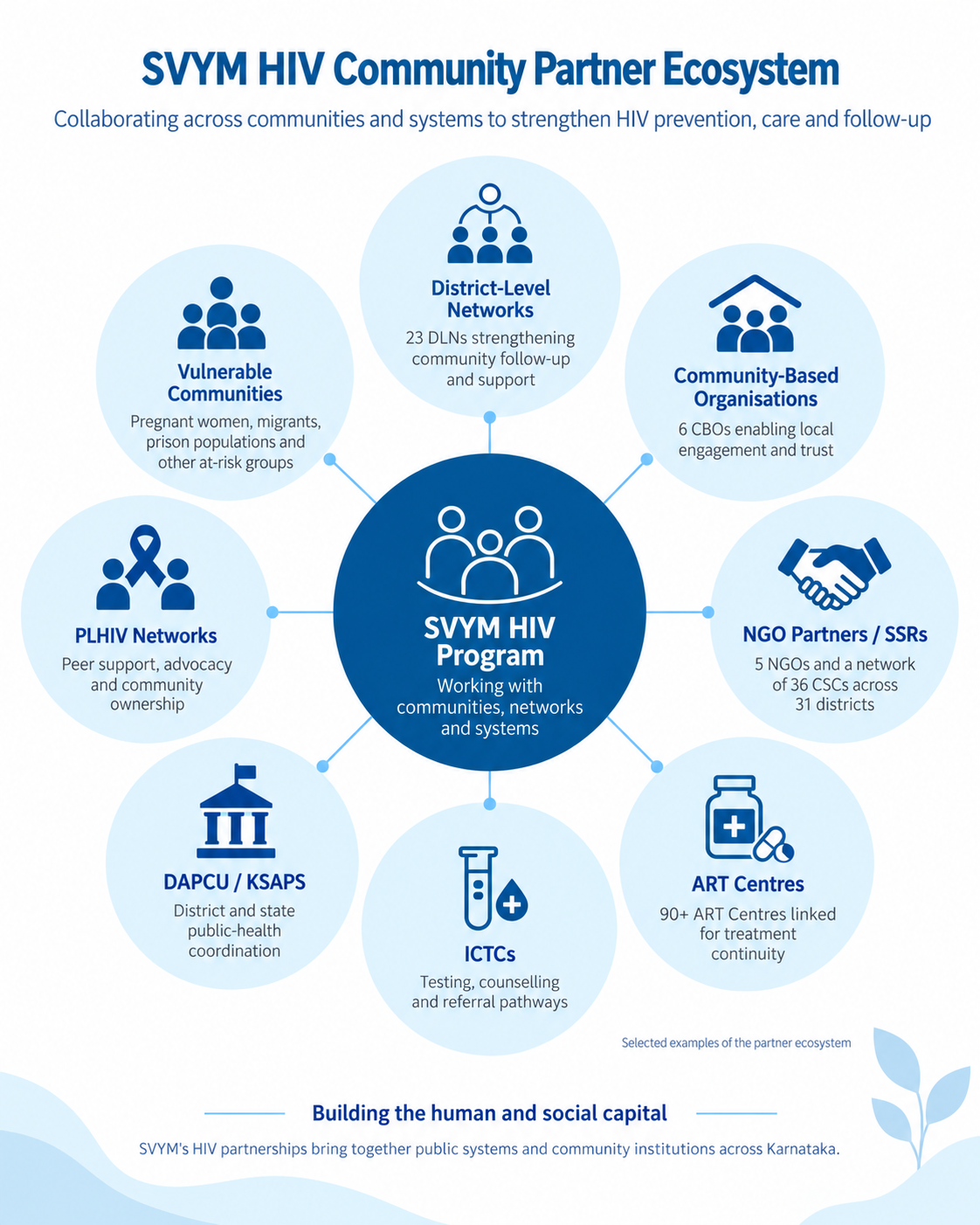
SVYM's HIV work has developed around prevention, testing, counselling, treatment linkage, long-term follow-up and social support. It brings together Government HIV systems, hospitals, ART Centres, Integrated Counselling and Testing Centres, community networks, civil-society organisations and trained field teams.
Several early innovations emerged from VMH and SVYM's community-health experience. Historical milestones include a primary-health-care-level Prevention of Parent-to-Child Transmission intervention, a pioneering Government–NGO partnership for free antiretroviral treatment at Government Medical College premises in Mysuru, and a tribal-rural Integrated Counselling and Testing Centre at VMH.
Project Svetana demonstrated that SVYM could work at statewide scale while retaining the detailed follow-up required for pregnant women living with HIV and HIV-exposed infants. During COVID-19, field teams continued to arrange transport, medicines, testing, counselling and discreet delivery of treatment where disclosure within the household itself was a concern.
More recently, CSC 2.0 has expanded SVYM's role in decentralised implementation and treatment-retention systems across Karnataka, while Kshamta Kendra strengthens the knowledge and skills of the wider HIV-prevention workforce. Together, these layers reflect a shift from service delivery alone to building the human and social capital of the HIV response.
A statewide continuum built around treatment continuity
The figures below are selected FY 2025–26 indicators from different components of SVYM's HIV work. They should not be added together as a single beneficiary total.
FY 2025–26 · Indicators represent different programme functions and denominators.
From local care to a multi-layered statewide HIV response
SVYM's HIV journey reflects a gradual expansion of responsibility — from direct clinical and community care to statewide implementation, treatment-retention systems and workforce capacity building.
HIV care and control work begins
SVYM begins building a comprehensive family-centred approach to HIV prevention, treatment, care and support, rooted in rural and tribal health services.
VMH becomes a platform for pioneering HIV services
SVYM develops a primary-health-care-level PPTCT intervention, a pioneering Government–NGO partnership for free ART in Mysuru, and an Integrated Counselling and Testing Centre serving rural and tribal communities.
Targeted Intervention for migrants begins
The KSAPS-supported TI Migrant Project begins working with mobile and high-risk migrant populations through testing, STI screening, counselling, workplace camps and treatment linkage.
Preventing vertical transmission at scale
Project Svetana expands across Karnataka, combining antenatal HIV testing, ART linkage, partner testing, mother-baby tracking, Early Infant Diagnosis and provider capacity building.
Continuity despite lockdown
Teams maintained contact with HIV-positive pregnant women, arranged transport and testing, delivered medicines and groceries, and found discreet ways to protect confidentiality when household disclosure was a risk.
Clinical workforce development expands
Prashiksha and Kshamta Kendra strengthen laboratory technicians, ART care coordinators, outreach workers, peer educators, programme managers and monitoring staff across Karnataka.
CSC 2.0 deepens the implementation role
A decentralised network of 36 Care & Support Centres across all 31 districts focuses on retention, viral suppression, lost-to-follow-up tracking, mother-baby follow-up and community-led care.
Multiple pathways, one national goal
SVYM works with PLHIV, pregnant women, migrants, prison inmates and other closed-setting populations while strengthening the organisations and workforce that sustain the HIV response.
The clinical protocol is shared. The barriers to care are not.
SVYM's programmes are designed around the realities faced by each population — adapting outreach, counselling and follow-up while remaining aligned with national HIV protocols and targets.
Protecting two lives through one continuum
Testing, ART adherence, viral-load monitoring, safe delivery, infant prophylaxis and Early Infant Diagnosis are connected through mother-baby tracking and close follow-up.
Care that moves with a mobile population
Workplace camps, counselling, STI screening, culturally relevant communication and ART linkage help reduce the gaps created by migration and irregular access to services.
Continuity even when people are transferred or released
Integrated HIV, TB, STI and hepatitis screening is combined with counselling, peer education and follow-up when inmates move between facilities or return to the community.
Retention is a relationship, not only a reminder
Repeated calls, home visits, tele-counselling, community networks and ART–CSC coordination help reconnect clients who have interrupted treatment or monitoring.
Services without judgement
Targeted interventions work with populations including sex workers, MSM, transgender persons and people who inject drugs through trained NGOs, CBOs and service providers.
Institutional care linked to the last mile
VMH's counselling and testing services connect with outreach camps, ART linkage, TB cross-referral and family-centred support closer to rural and tribal households.
The organising principle: national goals become meaningful when systems are local enough to earn trust, protect confidentiality, respond to stigma and stay connected to people throughout treatment.
Several programmes. One connected HIV care ecosystem.
Bringing people back into treatment and monitoring
CSC 2.0 operates across all 31 districts through 36 CSCs / Sub-Sub-Recipient partners. The network prioritises newly initiated ART clients, people lost to follow-up, pregnant women living with HIV, HIV-exposed infants, clients with unsuppressed viral load and people on third-line ART.
Building the capability to prevent vertical transmission at scale
Project Svetana demonstrated SVYM's ability to work across Karnataka while maintaining close follow-up of pregnant women living with HIV and HIV-exposed infants. In 2023–24, more than 1.4 million ANC HIV tests were recorded, EID at two months reached 97.58%, and nearly all babies born to HIV-positive mothers received preventive ARV prophylaxis.
That experience continues within newer HIV systems through mother-baby tracking, EID follow-up and viral-load monitoring.
Integrated care where access depends on institutions working together
SVYM works across prisons and other closed settings through integrated HIV, TB, syphilis and hepatitis services. In FY 2025–26, the programme covered 226 prison and closed-setting facilities, with stronger coordination between prison authorities, DAPCUs, ART Centres, ICTCs, de-addiction centres and health teams.
Prevention and treatment linkage for a mobile workforce
Initiated in 2012, the TI Migrant Project works across Mysuru district through workplace health camps, testing, STI services, counselling and referral. In FY 2025–26, 7,623 migrants were screened for HIV and all 20 individuals diagnosed with HIV were linked to ART centres.
Kshamta Kendra: strengthening the people behind HIV prevention and care
SVYM is one of 19 Kshamta Kendras selected across India. Anchored through V-LEAD, the initiative strengthens the knowledge and skills of HIV prevention service providers from NGOs and CBOs working with high-risk groups.
The programme has trained outreach workers, peer educators, programme managers, monitoring and evaluation staff and other HIV-service personnel. Earlier programme design envisaged building the capacity of approximately 900 individuals across 70 NGOs in Karnataka; the initiative has since expanded its training reach, with 1,646 participants reported in FY 2025–26.
Why it matters: SVYM's contribution to the HIV response is not limited to the people it serves directly. By strengthening service providers and partner organisations, it helps improve quality across a much wider care ecosystem.
Recognition across different stages of the HIV journey
The recognitions below span direct care, prevention of vertical transmission and targeted interventions — reflecting the programme's evolution over time.
Civil Society National Award
UNAIDS recognition for outstanding contribution in the HIV/AIDS sector.
Karnataka State AIDS Prevention Society Award
Recognised for unstigmatised and non-discriminatory care of a large number of HIV-positive pregnant women and their delivery care.
Best-performing Targeted Intervention
SVYM's TI project was recognised by KSAPS as a best-performing TI, selected from 78 TI projects / sectors working in Karnataka.
Best TI Project / Best Performance
At the State-level World AIDS Day programme, SVYM's Mysuru Targeted Intervention project was recognised among the best-performing TI projects in Karnataka.
Institutional firsts documented by SVYM: a primary-health-care-level PPTCT intervention; a first-of-its-kind Government–NGO partnership for free ART at Government Medical College premises in Mysuru; and a VMH tribal-rural ICTC described in SVYM's annual reporting as India's first and only of its kind.
Behind every indicator is a relationship that has to hold.
These stories show what continuity, confidentiality and dignity can mean in everyday HIV care.
When confidentiality changed where medicines could be delivered
During the pandemic, regular check-ups, labour referrals, COVID testing and timely medicines became difficult for HIV-positive pregnant women. SVYM team member Chandrashekar continued tracking mothers by phone, arranging transport and ensuring that mothers and babies received medicines and essential support.
In families where the mother's HIV status had not been disclosed, medicines sometimes had to be handed over away from home — even at temples — so treatment could continue without compromising confidentiality.
From lifelong HIV care to an HIV-free child
Charitha had lived with HIV since birth and remained connected to care through VMH. As an adult, counselling and clinical support helped her navigate marriage, reproductive choices, pregnancy and the anxiety of possible vertical transmission.
After regular pregnancy care and 18 months of follow-up for her baby, the final test in January 2025 confirmed that her child was HIV-free. Her story illustrates what long-term HIV care can make possible: health, relationships, parenthood and a life not defined by diagnosis.
Finding the person behind a “lost-to-follow-up” line
A treatment record can say that a client is overdue. Re-engagement requires more: repeated calls, home visits, tele-counselling, verification with ART and CSC records and, often, the trust of a community network that understands why the person stepped away.
That relationship-centred approach shaped CSC 2.0's FY 2025–26 work, where tens of thousands of LFU and overdue viral-load cases were actively followed across Karnataka.
Statewide scale remains connected to a place where care is personal
Vivekananda Memorial Hospital remains an important institutional anchor for HIV counselling, testing, treatment linkage and family-centred care among rural and tribal communities.
Integrated Counselling & Testing
VMH's ICTC provides confidential testing and counselling with referral to ART and related services, supported by outreach into tribal settlements.
HIV–TB Cross Referral
Integrated HIV and TB services support early identification of co-infection and reduce the risk of people being lost between separate disease programmes.
Family-centred Clinical Support
Counselling, reproductive-health guidance, maternal care and long-term follow-up help PLHIV make informed decisions while protecting dignity and confidentiality.
Ending AIDS depends on the strength of the whole care ecosystem
SVYM's experience spans direct service delivery, community networks, statewide implementation and workforce development. Partnerships can strengthen treatment retention, high-risk-group services, mother-baby care, testing, community capacity and the institutions that sustain them.
Retention & viral suppression
Strengthen tracing, counselling, treatment adherence and monitoring for people most at risk of interruption.
Prevention of vertical transmission
Support mother-baby tracking, EID, viral-load monitoring and provider capability.
High-risk & vulnerable populations
Extend targeted, stigma-sensitive prevention and treatment linkage to populations that face structural barriers.
Workforce capacity
Invest in Kshamta Kendra and other learning platforms that improve the quality of HIV prevention and care across organisations.
Data & systems
Strengthen data quality, referral pathways, supportive monitoring and coordination across Government and community systems.
Dignity & social support
Support approaches that reduce stigma, protect confidentiality and help PLHIV access entitlements and community support.
Partner with SVYM to strengthen the HIV care continuum
From a mother and newborn to a statewide care network, meaningful HIV outcomes depend on continuity, capability and trust. Join SVYM in strengthening the people, communities and systems working towards ending AIDS by 2030.