
Rural Entrepreneurship, Employment & Income Generation
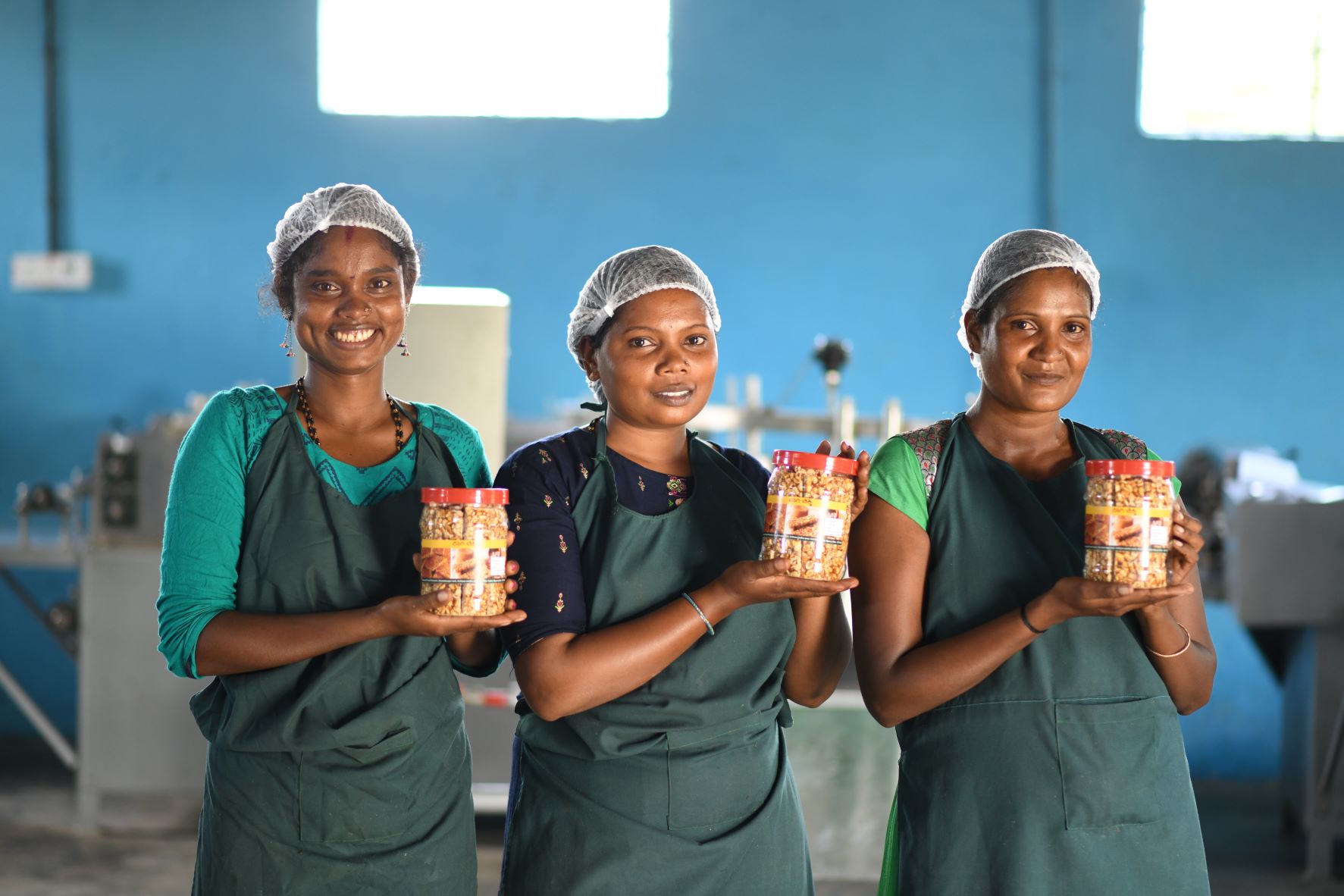
From collective strength to collective enterprise. Rural Social Business Units enable women—especially tribal women organised through Self Help Groups—to build enterprises, local livelihoods and economic opportunity together.
Objective
To enable women-led group entrepreneurship by building the skills, collective institutions, production systems, market capability and partnerships required for community-managed enterprises to become viable local livelihood platforms.
When social capital becomes an economic platform
SVYM's Rural Social Business Units grow from an important foundation: women who have already learnt to save together, solve problems together and take collective responsibility through Self Help Groups. Enterprise is the next expression of that collective capability.
Read more about the rural enterprise journey
The model began with Prakruthi Food Products at Jaganakote Hadi in 2017. The first unit demonstrated that tribal women could move beyond being beneficiaries or wage workers and become producers, managers, marketers and local economic actors in their own right.
Build human capital. Build social capital. Enable economic consequences that are increasingly owned and managed by the community itself.
Why group enterprise?
Starting a business alone can be difficult when access to capital, markets, technical knowledge, mobility and confidence is limited. A group enterprise distributes responsibility, builds on existing relationships of trust and gives women a stronger platform from which to learn, negotiate, produce and sell.
From one unit to a portfolio of community enterprises
The early Jaganakote experience became a practical learning ground for other women's groups. Women from newer units learnt from those who had already navigated production, packaging, pricing and market challenges. Over time, additional enterprises emerged in food processing, tailoring, cold-pressed oil, millet products, snacks, catering and livestock-related inputs.
Several of these units have now moved beyond their start-up phase, reaching break-even and, in some cases, operating profitably. Their significance is not only the money they generate, but the capability that remains within the community.
Building human and social capital
Human capital: product skills, food processing, bookkeeping, quality, packaging, marketing, communication and business decision-making.
Social capital: SHGs, federations, peer learning, technical partners, market relationships and shared responsibility.
Economic consequences: sales, local employment, member earnings, productive assets and enterprises that retain more value within rural communities.
Community ownership: women progressively take responsibility for procurement, production, compliance, accounts, sales and the future direction of their units.
A growing portfolio of women-led rural enterprises
The current enterprise portfolio reflects the gradual movement from collective savings and training towards production, market participation and locally generated economic activity.
FY 2025–26 · Turnover and revenue figures are reported as business activity, not as profit.
Reading the financial data carefully: SVYM's reports use terms such as turnover, revenue, total sales and member earnings in different contexts. On this page, business-unit figures are presented only using the labels supported by the source data. Revenue or turnover should not be interpreted as profit.
Enterprise is built step by step — not handed over ready-made
The Rural Social Business Unit model combines community institutions, technical learning, infrastructure, quality systems and market capability. The aim is to help groups move progressively towards managing viable enterprises themselves.
Identify interested women
SHGs and community networks help identify women who are willing to learn, work together and take responsibility for a shared enterprise.
Exposure & peer learning
Visits to functioning units and interaction with experienced women entrepreneurs make the business journey tangible and locally relevant.
Technical & product skills
Training is facilitated with technical institutions and sector partners, including organisations such as ICAR, KVKs and CFTRI, depending on the product and enterprise.
Infrastructure & capex
Funding partners, local institutions and SVYM help bridge the start-up gap through workspace, machinery, equipment and other productive assets.
Quality & compliance
Groups are supported on hygiene, production discipline, packaging, labelling and relevant registrations and standards such as FSSAI where applicable.
Branding & packaging
Products are prepared for the market through better packaging, product identity, pricing and communication.
Marketing & market access
Training, fairs, institutional buyers, local markets and exposure to other businesses help groups understand customers and routes to market.
Accounts, review & growth
Ongoing mentoring supports procurement, bookkeeping, sales, production planning, problem-solving and the gradual transfer of responsibility to the group.
The first unit became a learning platform for the next
Prakruthi Food Products at Jaganakote, established in 2017, became more than a production unit. Women from newer enterprises could learn directly from peers who had already experienced the realities of procurement, production, packaging and selling. This peer-to-peer transfer is one of the strongest forms of social capital within the model.
Ten functioning enterprises. Different products. One community-owned model.
The current portfolio spans food processing, tailoring, edible oils, millet products, catering, snacks and livestock inputs. Add one photograph for each unit in the image variables at the top of Part 1.
Prakruthi Girijana Mahila Okkuta
A women-led enterprise platform connected with the tribal women's federation and local market activity.
FY 2025–26 reported revenue: ₹15.26 lakh
Prakruthi Food Products
The first Rural Social Business Unit, established in 2017, and an important learning site for women from newer enterprises.
FY 2025–26 reported revenue: ₹17.70 lakh
Vanasiri Tailoring Unit
A group livelihood unit using tailoring and production skills to create local work opportunities for women.
FY 2025–26 reported revenue: ₹6.94 lakh
Prakruthi Cold Press Oil Unit
A women-managed processing enterprise adding value locally through cold-pressed oil production.
FY 2025–26 reported revenue: ₹7.74 lakh
Prakruthi Millet Products
A millet value-addition unit producing market-ready foods from locally relevant grains.
FY 2025–26 reported revenue: ₹5.79 lakh
Prakruthi Chips Making Unit
A community production unit creating a local processed-food livelihood pathway.
FY 2025–26 reported revenue: ₹3.79 lakh
Prakruthi Millet Canteen
A women-managed food enterprise connecting traditional millet recipes, health, local sourcing and market demand.
FY 2025–26 reported sales: ₹11.83 lakh
Prakruthi Chikki Making Unit
A tribal women's group enterprise processing millet into value-added foods and connecting production with local markets.
FY 2025–26 reported revenue: ₹4.72 lakh
Shree Brundhavana Food Products
An enterprise extending the group-business approach beyond the original H.D. Kote–Saragur geography.
FY 2025–26 reported revenue: ₹4.54 lakh
Silage Production Unit
Managed by 10 women and rural youth, the unit supplies affordable fodder to livestock farmers and broadens the enterprise portfolio beyond food products.
457 bags sold; reported revenue about ₹1.18 lakh
Financial interpretation: Unit-level numbers above are labelled exactly as revenue or sales based on the available annual-report data. They are not profit figures. The Silage Unit was inaugurated during FY 2025–26 and its revenue is reported separately in the narrative.
One grain connecting farming, enterprise, mobility and nutrition
Millet demonstrates how a local economy can be strengthened when different parts of the value chain are connected — from cultivation and processing to packaging, transport, sale and consumption.
From the field to a local enterprise ecosystem
Farmers in H.D. Kote and Saragur are being supported to revive locally rooted varieties of millet through seeds, soil testing, improved farming practices and agricultural infrastructure. In 2025–26, 547 farmers cultivated millet across 501.4 acres, while 332 farmers revived traditional varieties including Navane, Oodalu, Same, Korale and Sajje.
The grain then enters value-addition enterprises where tribal women process millet into chikki, pappad, infant food, millet bars and other products. Packaging, local transport and retail complete the next steps of the chain.
Current millet-economy indicators
₹1.91 crore generated through millet cultivation in 2025–26.
₹11.83 lakh in sales recorded by the women-managed Prakruthi Millet Canteen.
3,767.5 quintals of finger millet harvested, with reported productivity increasing to 7.5 quintals per acre.
From soil to the next generation
The 2025–26 Annual Report captures this chain through Pavithra's journey. Millet grown by local farmers moves to the Chikki Making Unit where tribal women add value; solar-charged e-rickshaws help move products to the Prakruthi Millet Canteen and Viveka Tribal Centre for Learning; at VTCL, millet returns to the plate through the school meal. The same grain therefore links farming, women's enterprise, clean mobility, local markets, nutrition and education.
Reviving more than a crop: Earlier reporting also records tribal farmers bringing several ancient millet varieties back into cultivation and consumption. The intention is both economic and cultural — to create value around locally suited grains while strengthening healthier food traditions.
Community ownership is strengthened by the right ecosystem of partners
The women run the enterprise. Around them, SVYM brings together technical institutions, government systems, funders, market partners and peer enterprises to address the different capabilities a young business needs.
Technical institutions
Organisations such as ICAR, Krishi Vigyan Kendras and CFTRI support specialised learning, product development and technical exposure according to the enterprise.
Government convergence
Local government bodies and departments can support workspace, schemes, agriculture inputs, registrations and other enabling infrastructure.
Funding & capex partners
CSR and philanthropic partners help bridge the initial capital gap for machinery, productive assets, infrastructure and market readiness.
Markets & buyers
Fairs, exhibitions, institutional buyers, local retail and partner networks help products move beyond production into sustained sales.
Support across the entire enterprise journey
The model does not stop after technical training or equipment installation. Women are supported on product consistency, packaging, hygiene, FSSAI and other relevant compliance, bookkeeping, pricing, marketing, branding, customer feedback and exposure to functioning businesses.
The goal is not permanent dependence on project support. It is to gradually build the confidence and systems required for the group to take more decisions and manage more of the enterprise independently.
An example from Hunsekuppe
SVYM's earlier documentation records how the Hunsekuppe unit drew on several forms of partnership: women trained with the experienced Jaganakote group; the Gram Panchayat enabled use of an existing building; equipment was supported by Texas Instruments; and solar lighting was supported by Collins Aerospace and installed by SELCO Foundation.
Enterprise works because it is connected to a larger development ecosystem
The Rural Social Business Units sit at the intersection of community institutions, skills, agriculture, energy, mobility, markets and education. That interconnection is what makes them useful as a live expression of SVYM's development paradigm.
Self Help Groups → Enterprise
Collective savings, meetings and mutual trust create the social foundation from which women can take on shared business responsibility.
VRLC → Skills
Vocational, entrepreneurship and livelihood training strengthen the individual capabilities required within group enterprises.
Agriculture → Raw Material
Millet and other farm-based initiatives connect producers with local value addition, keeping more of the economic chain closer to rural communities.
Energy → Productive Use
Solar lighting and electric mobility can support production, transport and market access while reducing dependence on conventional energy.
Markets → Confidence
Exhibitions, fairs and direct customer interaction help women test products, understand demand and build the confidence to represent their own enterprises.
Education → Nutrition
Millet products entering VTCL's food ecosystem demonstrate how local enterprise can also strengthen nutrition and reconnect the next generation with traditional foods.
Human capital + social capital → economic consequences
The business units make this idea visible. Individual skills alone are not enough; collective institutions alone are not enough; infrastructure alone is not enough. When skills, trust, productive assets, partnerships and markets come together, communities gain a stronger platform to create and retain economic value locally.
Explore the wider socio-economic empowerment ecosystem
Group enterprise is one pathway within SEEP. Other initiatives strengthen community institutions, skills, voice, agriculture and energy access around it.
Integrated Tribal Development
Self Help Groups, social entitlements, community strengthening, government convergence and locally rooted development with tribal communities.
Page to be linked after publicationViveka Rural Livelihood Centre
Learn locally, earn locally — vocational skills, employment, self-employment, enterprise and livelihood pathways.
Janadhwani Community Radio
A community communication platform connecting health, education, agriculture, public systems, culture and participation.
Sustainable Agriculture & Farmer Livelihoods
Millets, diversified farming, farmer institutions, technical training, water security and government convergence.
Page in developmentEnergy Equity for Tribal Communities
Solar electrification, clean cooking and productive clean-energy applications that strengthen everyday opportunity.
Socio-Economic Empowerment
See how livelihoods, collective institutions, enterprise, voice, entitlements and community agency connect across SEEP.
Experience SVYM's Rural Social Business Units
Visit the units to understand how Self Help Groups, training, partnerships and enterprise come together — or contact the team to enquire about products made by the community enterprises.