
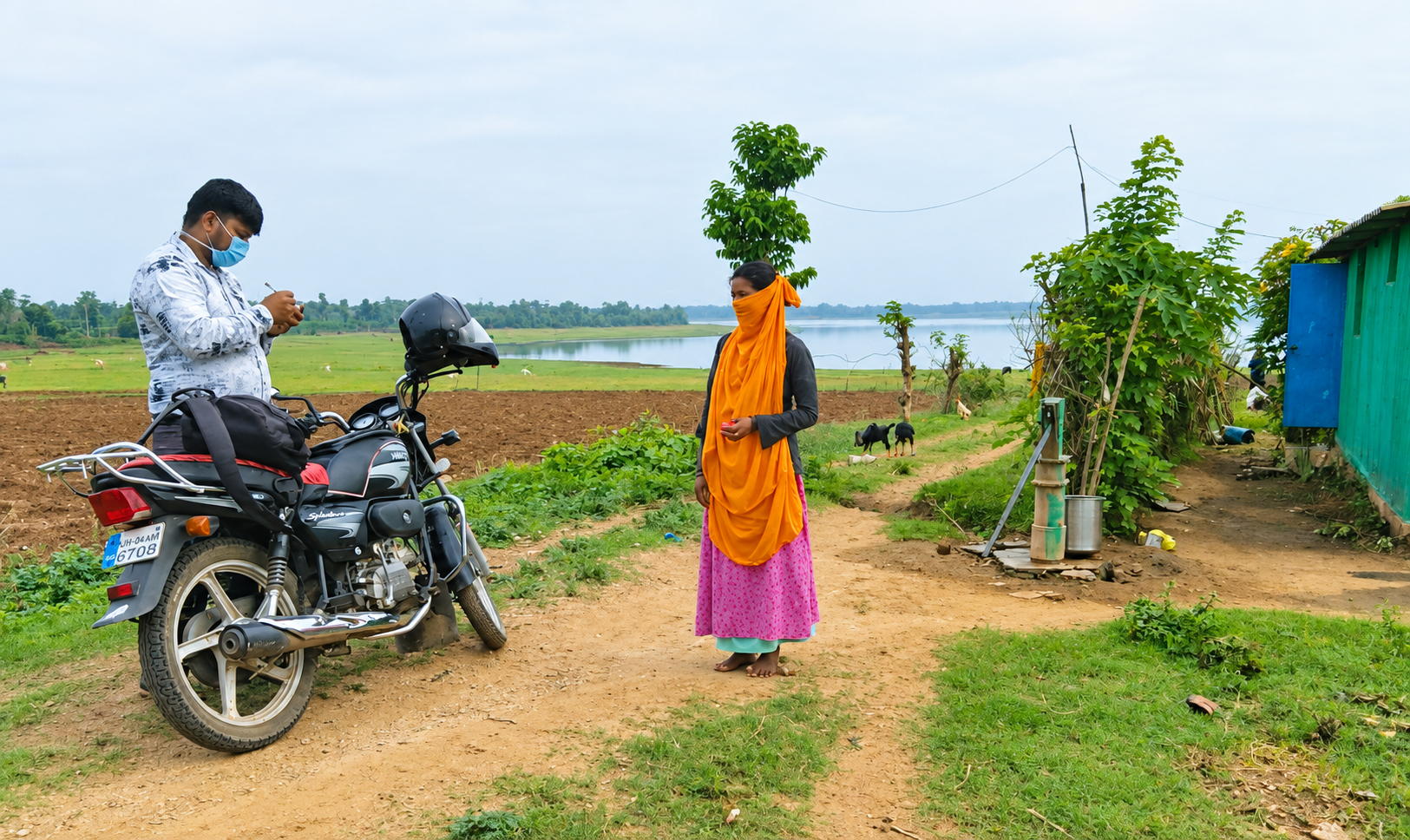
Finding TB early. Staying with the person until cure.
TB Care & Treatment at SVYM has grown from long-term work with indigenous tribal communities in H.D. Kote and Saragur into newer statewide models for paediatric TB and technology-enabled active case finding — while retaining the same principle: diagnosis matters only when a person can reach, continue and complete treatment.
Objective
To reduce illness and death due to tuberculosis through early identification, accessible diagnosis, treatment completion, nutritional and psychosocial support, and strong linkage with the public health system — particularly for tribal, rural, paediatric and other vulnerable populations.
A public-health programme shaped by the realities of tribal life
SVYM began its structured TB programme in 2003, working with the Government's Revised National Tuberculosis Control Programme (RNTCP) and later the National Tuberculosis Elimination Programme (NTEP). For communities living in forest-edge and remote settlements, however, a standard treatment protocol was only the beginning.
Stigma, seasonal migration, long treatment duration, malnutrition, distance from diagnostic services and the risk of being lost to follow-up demanded a more local response. SVYM therefore linked community outreach with Vivekananda Memorial Hospital (VMH), counselling, DOTS, nutrition, HIV cross-referral, hospital care and repeated follow-up.
Read more about the evolution of SVYM's TB work
From 2003 to 2018, SVYM implemented the Government-run RNTCP for 15 years in the H.D. Kote–Saragur region. The work helped build long-term field experience in finding cases early, supporting people through months of treatment and adapting care to indigenous tribal communities whose access barriers were very different from those in urban settings.
VMH functioned as a diagnostic and treatment anchor, while mobile health teams and local health facilitators extended care into tribal hamlets. The approach included screening tribal people with cough even of short duration, identifying local DOTS support, tracing people who missed treatment, collecting sputum closer to home, supplying medicines, counselling families and linking critically ill patients to hospital care.
The programme also recognised that TB rarely exists as a purely clinical problem. Nutrition, tobacco and alcohol use, HIV, income loss, migration and family circumstances can all affect treatment completion. SVYM therefore connected TB care with nutritional support, de-addiction services, HIV testing and, where relevant, livelihood and social support.
Today, that grassroots experience sits alongside newer projects in paediatric TB and technology-enabled active case finding across Karnataka. The scale has changed; the principle has not: strengthen the public system by making it reachable, responsive and continuous for people most likely to be missed.
From local tribal TB care to technology-enabled case finding
These figures come from different years and programme models. They illustrate the evolution of SVYM's TB work and should not be added together or read as one continuous statistical series.
Historical local programme figures and current statewide project figures use different geographies and denominators.
More than two decades of adapting TB care to changing needs
The timeline reflects a shift from local implementation of a national programme to broader models that combine community experience, hospital capacity, nutrition, digital referral and portable diagnostics.
Structured TB programme begins
SVYM begins implementing the Government's RNTCP-linked TB work in Saragur and H.D. Kote, with VMH and community outreach forming the institutional and last-mile anchors.
Fifteen years of RNTCP implementation
Long-term engagement builds experience in DOTS, case finding, referral, follow-up and treatment retention among rural and indigenous tribal communities.
Continuity through the COVID-19 pandemic
Even during lockdowns, field teams sustained treatment through doorstep follow-up, medicine distribution and sputum collection. SVYM reported 1,641 tribal people screened and an 87% cure rate in the high-risk tribal belts served that year.
Retention remains the central challenge
1,314 tribal people were screened and 107 TB cases detected; patients were initiated on DOTS at VMH or referred to other centres. SVYM reported an 83% cure rate in the programme geography.
Nutrition and integrated referrals gain emphasis
TB care increasingly connected with nutrition support through Nikshay Mitra initiatives, while TB–HIV cross-referral systems were strengthened through SVYM's HIV and community-health platforms.
New statewide models take shape
SVYM expands into Integrated Pediatric TB and Technology-Enabled Active Case Finding, combining public and private clinical networks, portable X-ray technology, referral strengthening and targeted outreach.
Technology, scale and continuity converge
Handheld chest X-rays, AI-supported interpretation, NAAT linkage and QR-based paediatric referrals are used to reduce delay between community identification, diagnosis and treatment initiation across high-priority geographies in Karnataka.
The medicine may be standard. The pathway to completing it cannot always be.
In remote tribal communities, a TB programme has to account for how people live, move, work, eat, seek care and experience stigma. SVYM's response developed around those realities.
Screen early and proactively
Tribal people reporting cough were screened proactively rather than waiting for prolonged symptoms or severe illness. Community camps and outreach reduced the distance between suspicion and diagnosis.
Stay with the patient
DOTS, counselling, local treatment support and repeated home follow-up helped people continue months of therapy and brought those missing visits back into care.
Build treatment around mobility
Seasonal movement for work could interrupt therapy. Local DOTS support, health facilitators and coordination with the public system helped maintain continuity across changing locations.
Nutrition is part of recovery
Nutrition support, supplements and later Nikshay Mitra nutrition kits addressed a major determinant of recovery and treatment tolerance among vulnerable patients.
Cross-refer instead of working in silos
VMH's TB and ICTC services enabled screening of people with TB for HIV and vice versa, strengthening early detection and coordinated care.
Connect community care to VMH
VMH provides diagnosis, a dedicated microscopy/DOTS pathway and institutional care, including dedicated ICU wards with HEPA filtration for critically ill TB patients who require higher-level care and infection-control support.
Use counselling and trusted local communication
Health facilitators, family counselling, camps and community communication helped address fear, misconceptions and the social isolation that can undermine treatment.
See the person, not only the infection
Where relevant, TB care connects with de-addiction, livelihood, social support and family-level services so clinical treatment is supported by a more stable recovery environment.
The organising idea: SVYM does not seek to replace the public TB system. It works to make that system more reachable and usable for people who are easiest to miss — translating national protocols into a last-mile community pathway.
National TB elimination becomes real only when the last person completes the journey
SVYM's role is complementary: strengthen identification, reduce delay, improve referral, support treatment initiation and help people remain in care — while building the human and social capital needed for communities and systems to sustain better health outcomes.
New tools, wider geographies — the same focus on people who can be missed
SVYM's current TB portfolio builds on its long community-health experience while working at a wider systems level through paediatric referral strengthening and technology-enabled case finding.
Making the paediatric TB care pathway easier to complete
The project works across Karnataka to improve timely diagnosis and treatment for children aged 0–14 years, especially where affordability, access, malnutrition and referral gaps can delay care. QR-based referrals, sample transportation, hub-site strengthening, private-provider engagement and frontline sensitisation are used to reduce drop-offs between suspicion, evaluation and treatment.
Taking screening and diagnosis closer to vulnerable populations
Across nine high-priority districts, the project combines community micro-planning, handheld chest X-rays, AI-supported image interpretation, radiologist validation and confirmatory testing. The objective is to reduce the time and cost that often stand between a person at risk and a confirmed diagnosis.
Different programmes, one care principle: technology helps find people earlier; coordination and follow-up are what turn detection into treatment and treatment into recovery.
Sometimes “treatment adherence” means solving the problem outside the prescription
Persistence against resistance
Radika, an 18-year-old tribal woman, returned to care with fever and breathlessness after an earlier history of TB. She required prolonged treatment, hospitalisation and oxygen support. Her family's financial constraints and the absence of electricity at home made even discharge with an oxygen concentrator difficult.
SVYM's support therefore extended beyond medicines. The patient-support mechanism helped with investigations; VMH provided inpatient and isolation care; the team helped the family obtain an electricity connection; and health facilitators continued home visits, medicine support and follow-up after discharge.
Radika's health gradually improved and she was documented as completely cured of TB in June 2022. Her journey captures a central lesson of SVYM's TB work: the barrier that interrupts treatment may be medical, social, financial or infrastructural — and continuity depends on responding to the real barrier in front of the patient.
Support the journey from early detection to treatment completion
Partnership can strengthen the parts of TB care that determine whether vulnerable patients are found early, linked quickly and supported long enough to complete treatment.
Community case finding
Support outreach camps, frontline mobilisation and screening in high-risk and hard-to-reach populations.
Portable diagnostics
Enable handheld X-ray, sample transport and diagnostic linkages that bring testing closer to communities.
Nutrition support
Strengthen recovery and adherence through nutrition kits and targeted support for vulnerable patients and children.
Patient retention
Support counselling, tracing, home follow-up and treatment-continuation mechanisms for people at risk of dropping out.
Paediatric TB pathways
Improve early suspicion, referral, diagnostic capacity and treatment linkage for children with presumptive TB.
Health-system capacity
Build frontline and provider capability, referral coordination and local systems that remain useful beyond a single project.
TB care is stronger when it sits inside a connected health ecosystem
Vivekananda Memorial Hospital
VMH anchors diagnosis, DOTS/NTEP linkage and hospital care, with dedicated ICU wards equipped with HEPA filtration for critically ill TB patients requiring intensive care and infection-control support.
Community Health Outreach
Mobile Health Units and grassroots teams extend screening, follow-up, medicines and referral into remote tribal communities.
HIV Prevention & Control
Cross-referral between TB and HIV services supports early identification of co-infection and coordinated care.
Help make TB care reachable for people most likely to be missed
Support can strengthen community screening, paediatric diagnosis, portable technology, nutrition and the long follow-up required to help vulnerable patients complete treatment with dignity.