
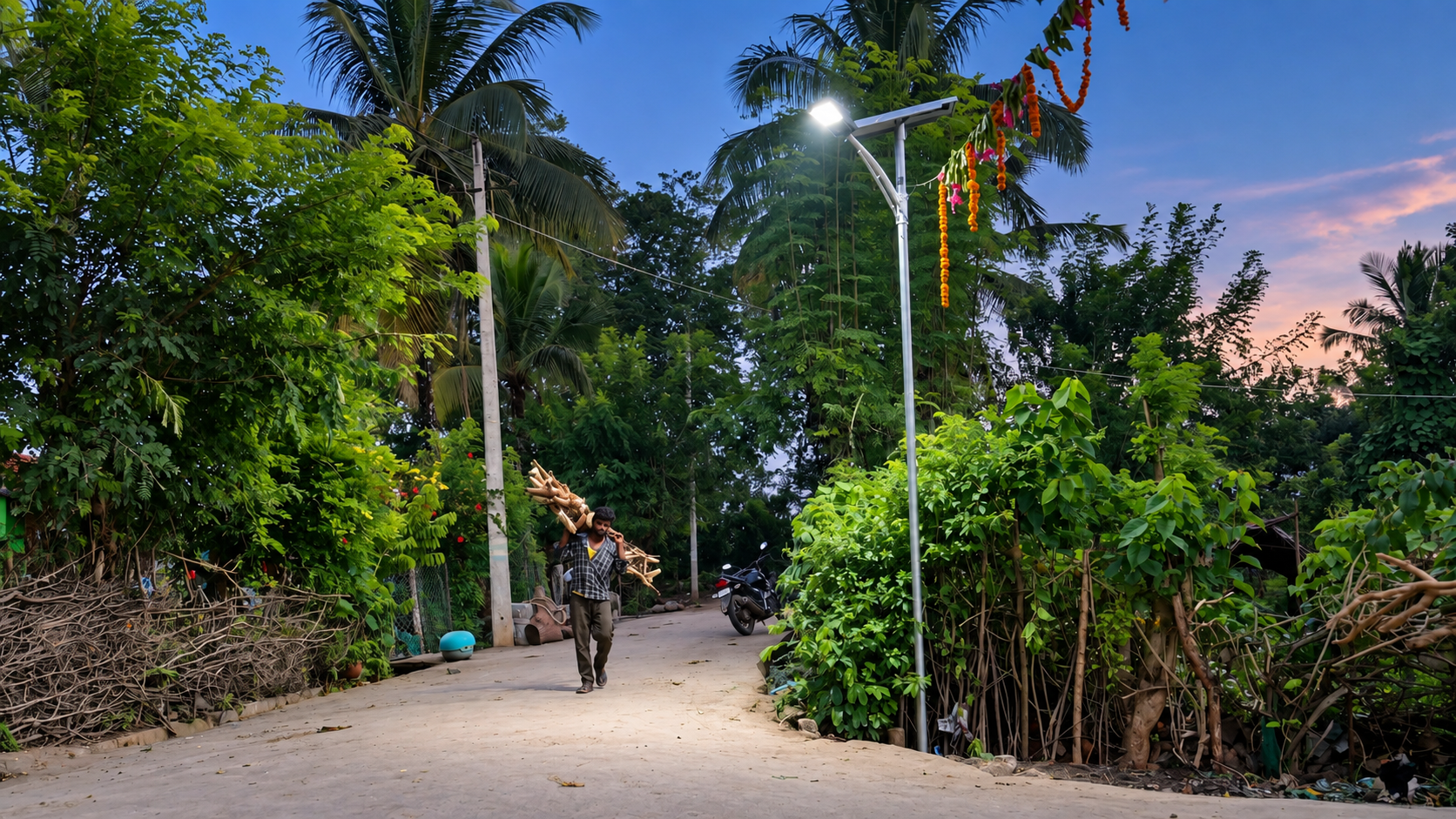
Energy Equity for Tribal Communities
From access to agency. Bringing reliable energy closer to remote communities — and connecting it with learning, safety, livelihoods, enterprise and greater freedom of choice.
Objective
To reduce energy inequity in remote tribal communities by improving access to reliable electricity, strengthening community ownership of energy systems, enabling productive use and connecting households with clean-energy and public electrification pathways.
Energy is not only infrastructure. It is an enabler of everyday opportunity.
SVYM began its Solar Powered Tribal Habitations initiative in 2016 in H.D. Kote, responding to energy inequity in remote forest-fringe settlements. Over time, the work has evolved from household lighting to a wider approach linking energy with community ownership, productive livelihoods, clean cooking, mobility and government convergence.
Read more about the energy-equity approach
For a household without dependable electricity, the consequences extend beyond darkness. Evening study, movement after sunset, household work and livelihood activity are all affected. Energy access therefore becomes closely connected to education, safety, livelihoods and dignity.
Access is the beginning. Community ownership and productive use determine what energy can become.
From installation to ownership
The model does not treat a solar unit as the end of the intervention. Community representatives participate in user committees and savings for repair and maintenance, strengthening local responsibility for the systems created.
Building human and social capital
Human capital: knowledge to use, maintain and apply energy for everyday and productive purposes.
Social capital: user committees, Self Help Groups, collective savings and shared responsibility.
Economic opportunity: energy supporting processing, handloom, mobility and women-led enterprise.
Systems access: connecting eligible households to public electrification and clean-energy schemes.
From a few hamlets to a wider energy-equity ecosystem
The initiative has expanded progressively while connecting direct renewable-energy interventions with government electrification and livelihood applications.
Latest figures: FY 2025–26. Solar installations, public electricity connections and Gobar Gas units are distinct interventions and are not combined.
A growing journey of energy access
The initiative began in 2016 and expanded progressively across tribal habitations in H.D. Kote. These milestones show how household access and livelihood use have developed over time.
2018 · Chikkabaragi & Vaderahalli
100% solar electrification was reported for the habitation, benefiting all 33 families and extending productive evening time for learning, earning and recreation.
2019 · Hunasekuppe
51 solar installations were linked with a women-managed ragi processing enterprise, demonstrating productive use of energy.
2020 · Kanthana
38 solar installations supported 100% electrification of the hamlet's 21 families, alongside a women-managed handloom enterprise.
2022 · Koodagi & Alanahalli
75 solar installations were reported, directly benefiting around 172 people in Koodagi and 101 people in Alanahalli.
2024 · Dadadahalli & Beddalapura
Solar electrification of the two tribal hamlets benefited 40 families through partnership with Trellix India.
2025–26 · 12 hamlets
SVYM's latest Annual Report records 12 tribal hamlets powered by solar installations, reflecting continued expansion of the initiative.
Continuity matters: the purpose is not merely to install equipment but to sustain access over time and connect energy to opportunities that matter in each habitation.
Community-owned systems are stronger systems
Access becomes more sustainable when communities understand the technology, participate in decisions and have mechanisms to maintain what has been created.
Community planning
Energy needs are understood in the context of households, safety, learning and livelihoods.
User committees
Community representatives share responsibility for local systems.
Maintenance funds
Collective savings support repair and maintenance arrangements.
Local capability
Basic technical knowledge reduces dependence on outside support.
Cheluva — an unlikely solar hero
SVYM's earlier documentation highlighted Cheluva, a young tribal community member who learnt to repair and manage solar equipment across three tribal hamlets. His story captures the larger intent: energy access becomes more sustainable when technical capability also lives within the community.
Electricity becomes transformative when it expands what people can do
Across SVYM's tribal development work, electricity is increasingly connected with livelihoods, enterprise and mobility — turning access into an economic and social enabler.
Handloom enterprise
At Kanthana Hadi, solar electrification sits alongside a Rural Social Business Unit managed by tribal women.
Ragi processing
At Hunasekuppe Hadi, solar access forms part of the wider ecosystem supporting women-managed millet processing.
Solar-powered mobility
Four Jenu Kuruba women were trained to operate the solar-powered Pink E-Auto enterprise.
Energy inside a local value chain
The millet ecosystem offers a useful example. Women process millet locally; solar-charged e-rickshaws can move products to the Prakruthi Millet Canteen and Viveka Tribal Centre for Learning; the same chain connects farmers, women entrepreneurs, transport and consumers.
More than an electricity connection
The development consequence comes from what energy makes possible: productive hours, enterprise activity, local transport, safer public spaces and new economic roles.
Where public systems can provide access, communities should be able to reach them
Energy equity is not limited to installing renewable-energy infrastructure. Another pathway is helping eligible families navigate and access government electrification programmes.
PM-JANMAN electricity connections
During 2025–26, Self Help Groups helped facilitate electricity connections for 428 families across 12 tribal hamlets under PM-JANMAN.
This demonstrates how community institutions can bridge remote households and public systems — helping families move from exclusion to access through existing government mechanisms.
Direct intervention + systems strengthening
Solar infrastructure can respond where conventional access is difficult. Government convergence can create durable public-service access where schemes are available. Using both pathways keeps the response contextual rather than technology-led.
Important distinction: the 428 PM-JANMAN connections are government-supported electricity connections and are not counted as solar installations.
Energy equity also enters the kitchen and the household economy
SVYM's wider rural clean-energy work includes household Gobar Gas systems that reduce dependence on firewood and LPG while creating a manure by-product useful to farming households.
A household energy solution linked to farming
Biogas systems convert livestock waste into cooking fuel. The by-product can also be used as manure, creating a practical connection between household energy and agriculture.
The initiative has been implemented with community participation and partner support, including collaboration with Titan Company Limited.
Malliga's experience
Earlier SVYM reporting documented Malliga Nagaraj of Jompanahalli describing savings of ₹500–₹1,000 per month on LPG and reduced dependence on firewood after installing a biogas unit.
Scope note: Gobar Gas is part of SVYM's wider rural clean-energy work and is presented here as part of the broader energy-equity ecosystem; it is not described as being limited only to tribal hamlets.
Energy connects many parts of community life
The strongest value of energy access is often visible outside the energy sector itself — in education, livelihoods, women's participation, food systems, agriculture and community institutions.
Energy → Education
Reliable light expands the time available for children and families to read, study and carry out household activities after sunset.
Energy → Women's Enterprise
Handloom, millet processing and mobility show how productive energy use can support women-led economic activity.
Energy → Agriculture
Biogas manure, solar-powered systems and clean mobility can strengthen different parts of farming and local value chains.
Energy → Community Institutions
User committees and Self Help Groups help communities organise around maintenance, public systems and collective responsibility.
Energy → Mobility
Solar-powered e-rickshaws connect clean energy with transport, women's participation and local supply chains.
Energy → Public Systems
PM-JANMAN convergence demonstrates how community organisations can help families access government infrastructure and entitlements.
Building the human and social capital behind the infrastructure
A solar panel can provide electricity. Community capability determines what that electricity becomes. By combining infrastructure with local knowledge, collective institutions, livelihoods and public-system access, energy becomes part of a wider process of building agency and expanding choice.
Explore the wider socio-economic empowerment ecosystem
Energy equity is one part of an interconnected development system that also strengthens institutions, skills, enterprise, agriculture and community voice.
Integrated Tribal Development
Self Help Groups, social entitlements, community strengthening, government convergence and locally rooted development with tribal communities.
Page to be linked after publicationViveka Rural Livelihood Centre
Learn locally, earn locally — vocational skills, employment, self-employment and enterprise pathways.
Janadhwani Community Radio
Locally relevant information connecting communities with agriculture, health, education and public systems.
Rural Entrepreneurship
Women-led Rural Social Business Units, production, local value addition, markets and enterprise development.
Sustainable Agriculture & Farmer Livelihoods
Climate-resilient cultivation, millets, farmer learning, water security, convergence and local food value chains.
Link after agriculture page is publishedSocio-Economic Empowerment
See how livelihoods, collective institutions, enterprise, voice, entitlements and community agency connect across SEEP.
Partner with communities to turn energy access into lasting opportunity
Support equitable energy access, community-owned systems, productive clean-energy applications and partnerships that help remote communities learn, earn and participate with greater choice.