
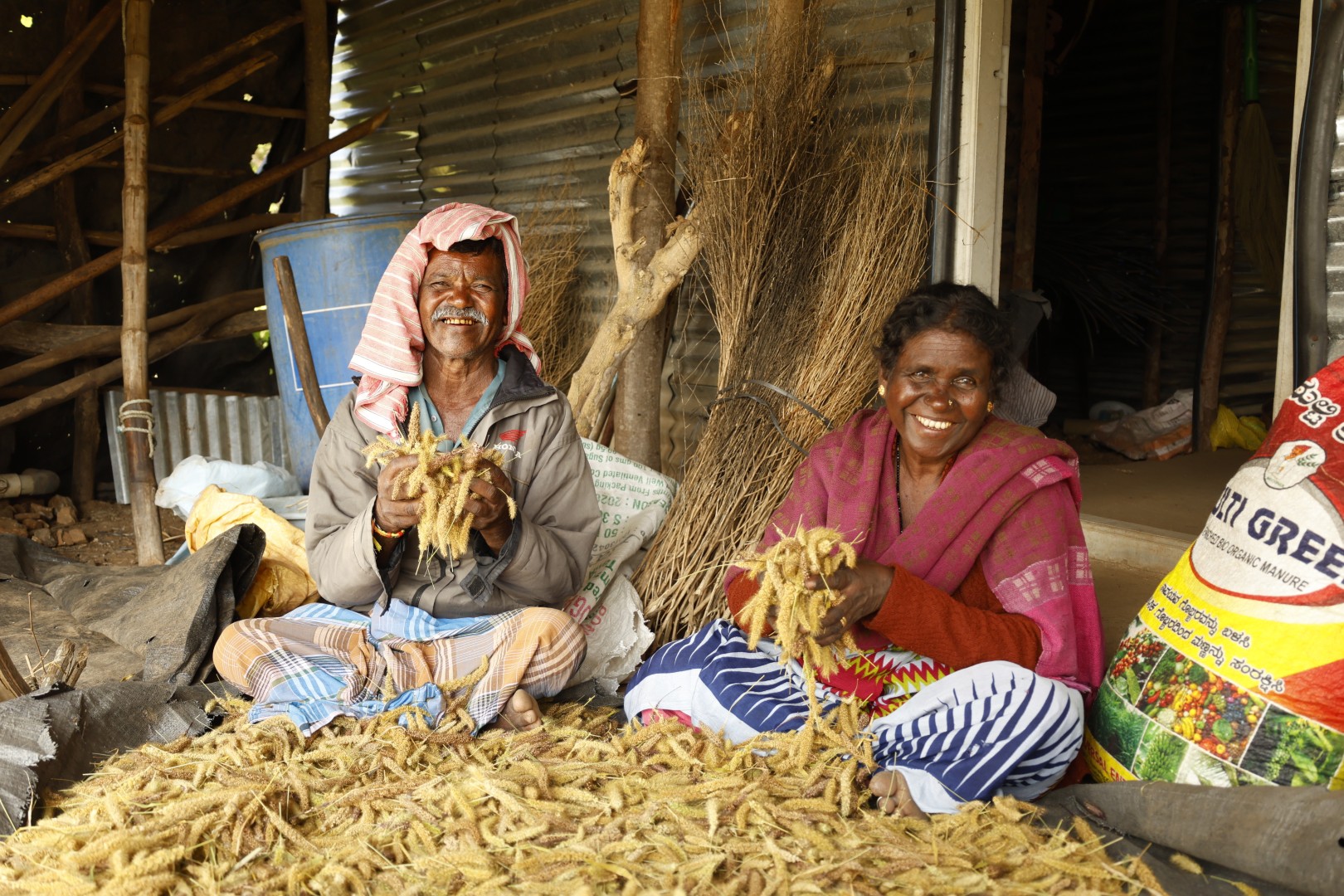
Sustainable Agriculture & Farmer Livelihoods
Growing resilient farms. Strengthening rural livelihoods. Building the human and social capital of farming communities through knowledge, sustainable practices, collective institutions and stronger local value chains.
Objective
To enhance the livelihoods and food security of rural and tribal farming communities through sustainable millet cultivation, diversified farming systems, farmer capacity building, quality inputs, water-resource development, women-led enterprises and convergence with government schemes.
Farming as a livelihood system — not a single crop intervention
Since 2022, SVYM has worked with rural and tribal farmers in H.D. Kote and Saragur to strengthen agriculture as a more resilient, productive and locally rooted livelihood. The approach combines farming knowledge, natural resources, farmer participation, public systems and local value addition.
Read more about the agriculture approach
Agricultural livelihoods depend on more than seed and rainfall. Farmers need relevant knowledge, water security, healthy soil, affordable inputs, access to government support, viable crops, markets and confidence that farming can remain a meaningful livelihood.
Strengthen the farmer. Strengthen the farm. Strengthen the institutions and value chains around both.
Climate resilience rooted in local context
Millets are central because they are locally familiar, nutritionally valuable and suited to dryland conditions. But the programme is broader than millet alone. It combines diversified farming, water and irrigation support, low-cost organic practices, agricultural inputs and local livelihood opportunities so that farming households can respond to changing climate and market conditions.
Building human and social capital
Human capital: farming knowledge, soil and water management, crop choices, technical skills and the confidence to experiment with improved practices.
Social capital: farmer networks, Self Help Groups, model farmers, learning platforms, research institutions and government partnerships.
Economic resilience: improved productivity, diversified income, value addition and stronger local markets.
Food and cultural resilience: reviving traditional grains and bringing them back into farms, kitchens and community food systems.
Community institutions at the centre
Self Help Groups and community networks help farmers access information, entitlements, inputs and collective platforms. Model farmers demonstrate practices to neighbours, while larger learning spaces such as the Viveka Krishi Mela connect local experience with science, government schemes and farmer-to-farmer learning.
2025–26 at a glance
The current evidence shows both the scale of farmer engagement and the programme's movement towards climate-resilient cultivation, year-round farming and stronger local economic activity.
FY 2025–26 · Promoting Sustainable Millet-Based Agriculture, SVYM
How we use income figures: financial figures are retained in the same form in which they are reported by the Annual Report. “Generated through millet cultivation” is not presented here as profit.
Strengthening the entire farming system
The programme combines crop choices, soil health, water, inputs, technical learning and livelihood diversification so farmers can reduce vulnerability and make more informed decisions about their land.
Farmer capacity
Training, demonstrations, model farmers and expert interaction build practical knowledge that can be applied on the field.
Soil & inputs
Soil testing, quality seeds, bio-inputs and low-cost organic practices help farmers improve crop planning and reduce avoidable costs.
Water resources
Groundwater recharge, irrigation support and community-managed infrastructure reduce dependence on unpredictable rainfall.
Farming systems
Millets, maize, cotton, horticulture, livestock and allied livelihoods broaden the choices available to farming households.
Government support
SVYM helps connect eligible farmers with public institutions, schemes, inputs and technical resources.
Local processing
Women-led units process farm produce locally, creating additional livelihood opportunities within the same economy.
Buyers & local demand
Market connections, fairs and enterprise platforms help create demand for locally produced and processed food.
Community resilience
When knowledge, income and institutions remain closer to the community, agriculture becomes part of a wider resilience strategy.
Lower-cost, locally manageable farming practices
In 2025–26, 55 vermicompost units and 25 Jeevamritha producers were promoted to support low-cost organic farming. These practices reduce reliance on purchased inputs while strengthening soil-health knowledge within the community.
Diversification beyond a single crop
The annual report records ₹80.66 lakh in additional farm income generated through maize and cotton cultivation, alongside the millet initiative and other agriculture-based livelihood pathways.
Reviving a crop, a food culture and a rural economy
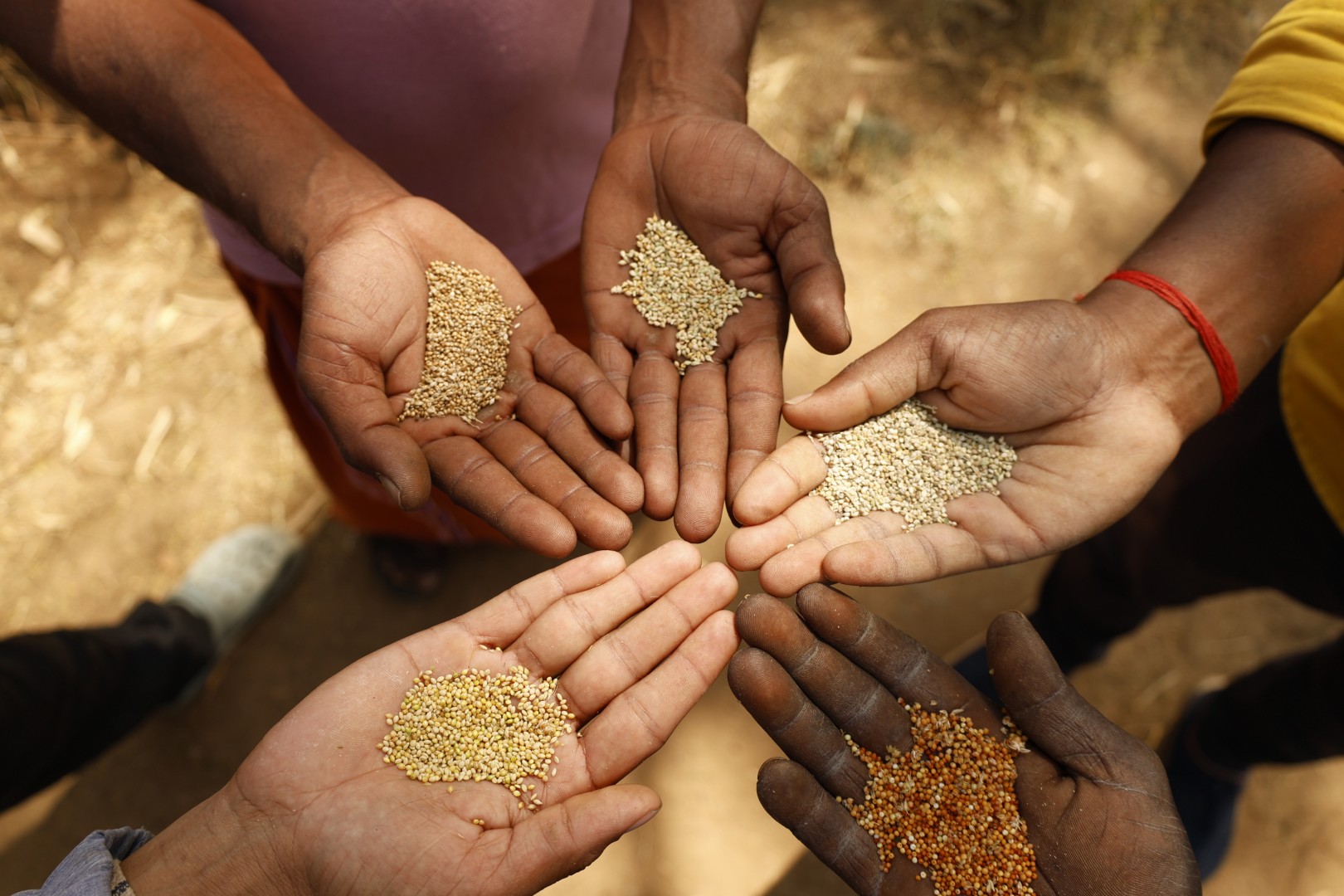
Millet has become one of the programme's strongest connectors because it brings together climate resilience, traditional knowledge, farmer income, women's enterprise, local consumption and nutrition.
were engaged in millet cultivation. The report described 2,713.91 quintals produced over roughly two years, valued at ₹1,16,54,760, across about 953 acres. Around 30% of supported farmers were women.
cultivated millet across 501.4 acres during the reporting year, while 332 farmers revived multiple traditional millet varieties.
Why these figures are not presented as a direct year-on-year growth chart: the 2024–25 report describes a cumulative production period of roughly two years, while the 2025–26 figures are reported for the current year. They are therefore shown as programme progression rather than as directly comparable annual totals.
Model farmers as local influencers
Earlier reporting highlighted nine model millet farmers from tribal communities. Farmers such as Krishnaiah and Nooralaiah demonstrated practices on their own fields, shared seed and experience with neighbours, and helped build confidence through evidence that was visible locally.
From tobacco and Chia towards locally rooted crops
For some farmers, millet represents a gradual shift away from crops that may be less aligned with local nutrition or soil conditions. The programme supports this transition through seeds, soil testing, farming techniques, irrigation support and market linkages.
Resilient farming begins with resilient natural resources
Water availability and soil health determine whether farmers can move beyond rain-dependent cultivation. The agriculture initiative therefore works with natural-resource measures alongside training and crop support.
Groundwater recharge
25 groundwater recharge units were established in 2025–26 to strengthen long-term water security.
Community irrigation
12 tribal families gained reliable irrigation after restoration of the Vaderalli Haadi check dam and a community-managed irrigation system.
Soil health
Vermicompost, Jeevamritha and soil testing strengthen locally manageable approaches to fertility and reduced cultivation costs.
From one rainfed crop to year-round possibility
At Vaderahalli Haadi, farmers had traditionally depended entirely on rainfall. Irrigation support through pumps, pipes and sprinklers enabled some farmers to attempt chilli cultivation for the first time, illustrating how basic water infrastructure can expand livelihood choice.
Knowledge grows when farmers, institutions and government learn together
SVYM uses field demonstrations, peer farmers, technical institutions, government convergence and large learning platforms to make agricultural knowledge more accessible and actionable.
Farmer-to-farmer learning
Model farmers demonstrate practices within the same social and ecological context, helping new ideas travel through lived evidence rather than instruction alone.
Technical partnerships
Krishi Vigyan Kendras, agricultural institutions, researchers and subject experts contribute training, demonstrations, planting material and technical guidance.
Government convergence
In 2025–26, agricultural inputs worth ₹23.96 lakh were mobilised through government institutions.
Viveka Krishi Mela 2026
The third Viveka Bruhath Krishi Mela brought together 3,100+ farmers from Mysuru, Chamarajanagar, Dharwad and Raichur. Government departments, research institutions, farmer leaders and community organisations created a shared platform for demonstrations, expert sessions, successful-farmer interaction and awareness of public schemes.
Participants explored poultry, fisheries, integrated farming and rural entrepreneurship, while women farmers and Self Help Groups showcased local enterprises.
Leadership as an outcome
At the 2026 Krishi Mela, Puttamma, a Jenu Kuruba tribal woman and President of the SHG Federation, addressed the gathering for more than 40 minutes. The moment reflects a broader outcome of the programme: farmers and community leaders becoming confident participants in knowledge and development spaces.
A women-led model bringing health and prosperity into the same local value chain
The Prakruthi Millet Canteen shows what can happen when agriculture does not end at the farm gate. A traditional grain becomes food, a market, a women's enterprise and a way of bringing millet consumption back into everyday community life.
From local crop to local food economy
Managed by tribal women, the canteen creates a direct connection between millet cultivation, value addition, food preparation and consumers. It creates a market for millet while demonstrating that healthier traditional foods can also support women-led livelihoods.
Health: encourages the return of millet-based foods to regular diets.
Prosperity: creates value beyond cultivation through preparation, service and sales.
Women's leadership: places tribal women at the centre of an enterprise that connects food, culture and local markets.
One grain, many journeys
Millet moves from farmers' fields to women-led processing units, into packaging and local transport, on to the Prakruthi Millet Canteen and even into meals at Viveka Tribal Centre for Learning. The chain connects farming, enterprise, mobility, nutrition, education and the next generation — making millet a practical example of integrated development.
A farm becomes stronger when the ecosystem around the farmer is stronger
Agriculture connects naturally with several parts of SVYM's work. Skills, Self Help Groups, enterprise, clean energy, education, community radio and public systems all influence whether farming can become a resilient livelihood.
Self Help Groups → Participation
Community institutions help farmers and women access information, schemes, collective learning and enterprise opportunities.
Janadhwani → Knowledge
Community radio carries agricultural information, farmer experiences, expert guidance and government information into rural households.
VRLC → Livelihood Skills
Agriculture-based training in dairy, poultry, sheep and goat rearing, sericulture and other areas strengthens allied farm livelihoods.
Enterprise → Value Addition
Women-led Rural Social Business Units create local processing, packaging, food and market pathways for agricultural produce.
Energy → Productive Use
Solar power, biogas and clean mobility can support irrigation, processing, transport and lower-cost rural production.
Education → Food Culture
Millet entering school meals at VTCL connects agricultural revival with childhood nutrition and the intergenerational continuity of traditional food.
Building the human and social capital of farming communities
The long-term goal is not simply higher production. It is farmers with more knowledge, stronger local institutions, better access to water and public systems, diversified livelihood choices and local value chains capable of retaining more economic and social value within the community.
Explore the wider socio-economic empowerment ecosystem
Sustainable farming is one part of a wider system that connects community institutions, skills, enterprise, voice and energy access.
Integrated Tribal Development
Self Help Groups, social entitlements, community strengthening, government convergence and locally rooted development with tribal communities.
Page to be linked after publicationViveka Rural Livelihood Centre
Learn locally, earn locally — skills, employment, self-employment and locally viable livelihoods.
Janadhwani Community Radio
A community communication platform connecting agriculture, health, education, public systems, culture and participation.
Rural Entrepreneurship & Income Generation
Women-led Rural Social Business Units, food processing, local production, markets and enterprise development.
Energy Equity for Tribal Communities
Solar electrification, clean cooking and productive clean-energy applications that strengthen everyday opportunity.
Socio-Economic Empowerment
See how livelihoods, community institutions, enterprise, voice, entitlements and agency connect across SEEP.
Partner with farming communities to build more resilient rural livelihoods
Support farmer learning, climate-resilient agriculture, water security, women-led value addition and the local institutions that help communities create opportunity from their own land and knowledge.